


Businesses communicate with customers every day. They send offers, updates, newsletters, product information, and important notifications.
Sending these emails one by one can take a lot of time. It also becomes difficult when a business has thousands of customers.
A Bulk Email Service helps businesses send emails to a large audience from one platform. It makes email campaigns easier to create, manage, and track.
From marketing campaigns to customer updates, bulk email can support many business needs.
In this guide, we will explain how bulk email works, its benefits, common uses, and how businesses can use it effectively.
What Is a Bulk Email Service?
A bulk email service allows businesses to send emails to multiple recipients at the same time.
Instead of sending every email manually, a business can create one campaign and send it to a selected customer list.
Businesses can use bulk email for:
- Marketing campaigns
- Newsletters
- Product announcements
- Customer updates
- Event invitations
- Offers and promotions
- Lead follow-ups
- Business notifications
The content can be prepared in advance and sent to the right audience based on the campaign goal.
How Does Bulk Email Work?
The process is simple and easy to manage.
A business first prepares the email content and selects the recipient list. It can then set the sender details, subject line, and campaign settings.
Before sending the campaign, the email should be tested to check the content and links.
A basic process looks like this:
Create Contact List → Prepare Email → Test Campaign → Send Email → Track Results
After sending, campaign reports can help businesses understand how recipients interacted with the email.
Why Do Businesses Use Bulk Email?
Email is useful for both marketing and regular customer communication.
When a business has a large customer base, manual email sending can become difficult. A bulk email platform can make this process more organized.
It can also help businesses maintain regular communication.
For example, a company can send a weekly newsletter or a monthly product update without creating every email from the beginning.
This saves time and gives the marketing team a more structured way to manage campaigns.
Bulk Email for Marketing
Marketing is one of the most common uses of bulk email.
Businesses can send campaigns to customers who have agreed to receive marketing communication.
A campaign may promote:
- New products
- Seasonal offers
- Discounts
- New services
- Events
- Company updates
- Educational content
A good email should have a clear subject line and useful information. The message should also have a simple call to action.
The goal is not to send as many emails as possible. The goal is to send relevant information to the right audience.
Bulk Email for Customer Communication
Bulk email is also useful outside marketing.
Businesses can use email to share information with existing customers.
For example, an e-commerce company may send order updates. A service company may send appointment information. An education business may share course updates.
Businesses can also combine email with a Bulk SMS Service when customers need short and time-sensitive updates.
Using different channels can help businesses choose the right way to communicate for each type of message.
Bulk Email for Lead Nurturing
Not every lead is ready to buy after the first interaction.
Email can help businesses stay connected with potential customers over time.
A simple lead-nurturing journey may look like:
New Lead → Welcome Email → Useful Information → Product Details → Follow-Up
This approach gives prospects more information before they make a decision.
Businesses can also use email to share educational content, service information, case studies, or answers to common questions.
The content should match the prospect’s interests and stage in the buying journey.
Email Automation for Business
Some emails need to be sent after a specific action.
Email automation can help businesses manage these repetitive tasks.
Common examples include:
- Welcome emails
- Follow-up emails
- Appointment reminders
- Event reminders
- Customer onboarding
- Renewal notifications
- Feedback requests
Automation can reduce repetitive work and help businesses maintain regular communication.
For more complex customer communication, businesses can also connect email campaigns with a Cloud Call Center and manage email and phone interactions as part of a wider workflow.
Personalization in Bulk Email
Bulk email does not have to feel generic.
Businesses can personalize emails using customer information available in their systems.
For example, an email may include the customer’s name or information related to their previous interaction.
Personalization should always be based on accurate data and used responsibly.
A relevant message can make communication more useful and easier for customers to understand.
How to Measure Email Campaigns
A professional email platform can provide useful campaign reports.
Depending on the platform, businesses may be able to monitor:
- Delivery rate
- Open rate
- Click rate
- Bounce rate
- Unsubscribe rate
- Campaign engagement
These metrics can help businesses understand what is working and what needs improvement.
For example, a high bounce rate may indicate that an email list contains invalid addresses.
A low click rate may show that the email content or call to action needs improvement.
Regular reporting helps businesses make better decisions for future campaigns.
Bulk Email vs Individual Email
Individual emails are useful for personal conversations and one-to-one communication.
Bulk email is designed for larger audiences and repeated business campaigns.
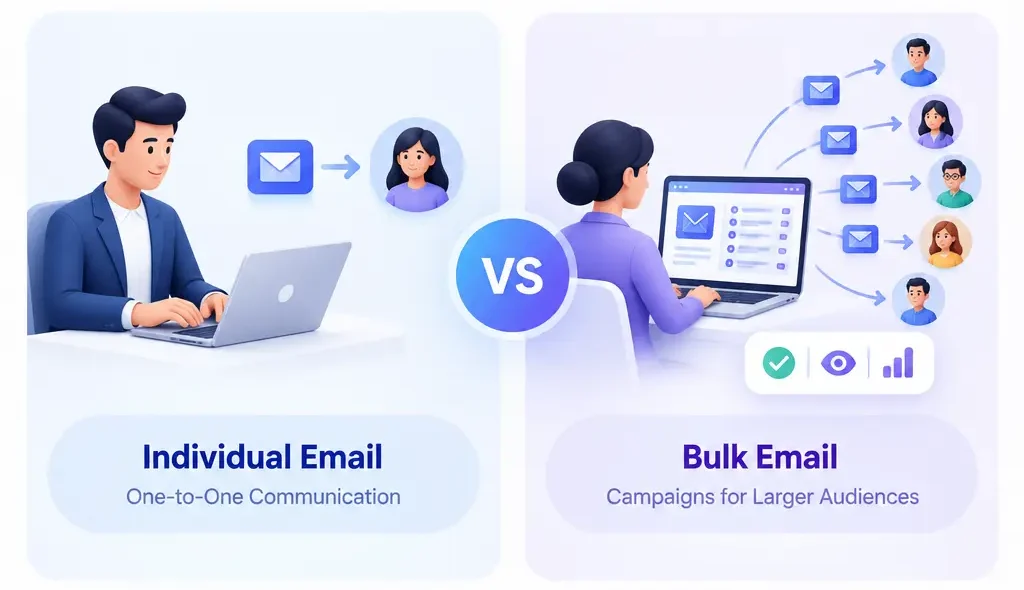
Both methods have their place. The right option depends on the purpose of the message.
Bulk Email and Other Business Communication
Email is one part of a wider communication strategy.
Some businesses may need voice calls, SMS, WhatsApp, or other channels along with email.
For example, an IVR Service can help manage incoming calls through structured call options.
A Click2Call Service can give website visitors a simple way to connect with a business.
Businesses can also use a Missed Call Service to capture customer interest through a missed-call response.
For customer inquiries, a Toll-Free Number can provide an easy way for customers to contact the business.
This multi-channel approach allows businesses to use each communication channel for a specific purpose.
Who Can Use Bulk Email Services?
Bulk email can be useful for businesses across different industries.
E-commerce
Online stores can use email for product announcements, offers, order communication, and customer updates.
Education
Educational institutions and training companies can share course information, events, and announcements.
Real Estate
Real estate companies can use email to share property information and follow up with interested prospects.
Healthcare
Healthcare businesses can use email for appointment information, service updates, and general customer communication.
B2B Companies
B2B businesses can use email for newsletters, lead nurturing, product information, and customer updates.
Best Practices for Bulk Email
A good campaign is about more than sending a large number of emails.
Follow these basic practices:
- Use permission-based email lists.
- Keep the subject line clear.
- Write useful and relevant content.
- Make emails mobile-friendly.
- Add a clear call to action.
- Keep customer data secure.
- Provide an easy unsubscribe option.
- Remove invalid email addresses.
- Monitor campaign performance.
- Test emails before sending them to a large audience.
These steps can help businesses build better and more responsible email communication.
How to Choose a Bulk Email Service
Before choosing a service, businesses should understand their requirements.
Consider factors such as
- Email volume
- Contact list size
- Campaign management
- Automation features
- Personalization
- Reporting and analytics
- API integration
- Customer support
- Scalability
- Data security
The right solution depends on the business size, audience, email volume, and communication goals.
Final Thoughts
A bulk email service can help businesses manage email communication at scale.
It can support marketing campaigns, customer updates, newsletters, lead nurturing, and automated communication.
However, successful email marketing is not only about sending more emails. Relevant content, permission-based communication, clean contact lists, and regular campaign analysis are equally important.
When email is combined with other business communication channels, companies can create a more organized customer communication strategy.
Businesses can send newsletters, offers, product updates, announcements, follow-ups, and other permitted business communications. Yes. It can support promotional campaigns, newsletters, product announcements, and lead nurturing. Yes. Depending on the platform, businesses can create automated emails for welcome messages, follow-ups, reminders, and other workflows. Use permission-based lists, relevant content, clear subject lines, mobile-friendly emails, and campaign reports to improve future campaigns.
What can businesses send through bulk email?
Is bulk email useful for marketing?
Can bulk email be automated?
How can businesses improve bulk email campaigns?