


A prospect fills in a form at 7 pm and gets no call until the next afternoon. A customer asks the same delivery question that your team answered fifty times today. A patient calls after clinic hours and reaches voicemail. Missed calls, slow follow-ups, and repetitive queries are common problems, especially when call volumes rise and teams are small.
AI voice agents offer one way to handle part of this load. They can take on selected, routine conversations and pass the rest to your people. This guide explains how AI voice agents work, where they fit, where they do not, and how to choose and test one for your business.
What Is an AI Voice Agent?
An AI voice agent is software that can answer or make phone calls and hold a conversation. It listens to what a person says, works out what they want, and replies in a natural voice. Businesses configure it for defined tasks, such as qualifying a lead, confirming an appointment, or answering common questions.
You may also see the terms AI calling agent, AI voice bot, and voice AI. They describe similar tools, though capabilities differ between products.
How Does an AI Voice Agent Work?
A call usually moves through these steps:
- Telephony connection. The call is placed or received through a phone network or cloud telephony platform.
- Speech recognition. The system turns spoken words into text.
- Natural language understanding. It works out the caller’s intent, such as “reschedule my appointment”.
- Response generation. AI decides what to say, based on your business rules and the information you give it.
- Text-to-speech. The reply is converted back into spoken audio.
- Business system integrations. When set up, the agent checks or updates a CRM or other tool.
- Human-agent transfer. If the call needs a person, it is passed to your team, ideally with context.
Quality depends on audio clarity, language support, how well the flow is designed, and what information the agent can access.
AI Voice Agents vs Traditional IVR Systems
IVR stands for Interactive Voice Response. It plays a menu such as “press 1 for sales,” and the caller selects an option. An AI voice agent lets the caller speak freely.
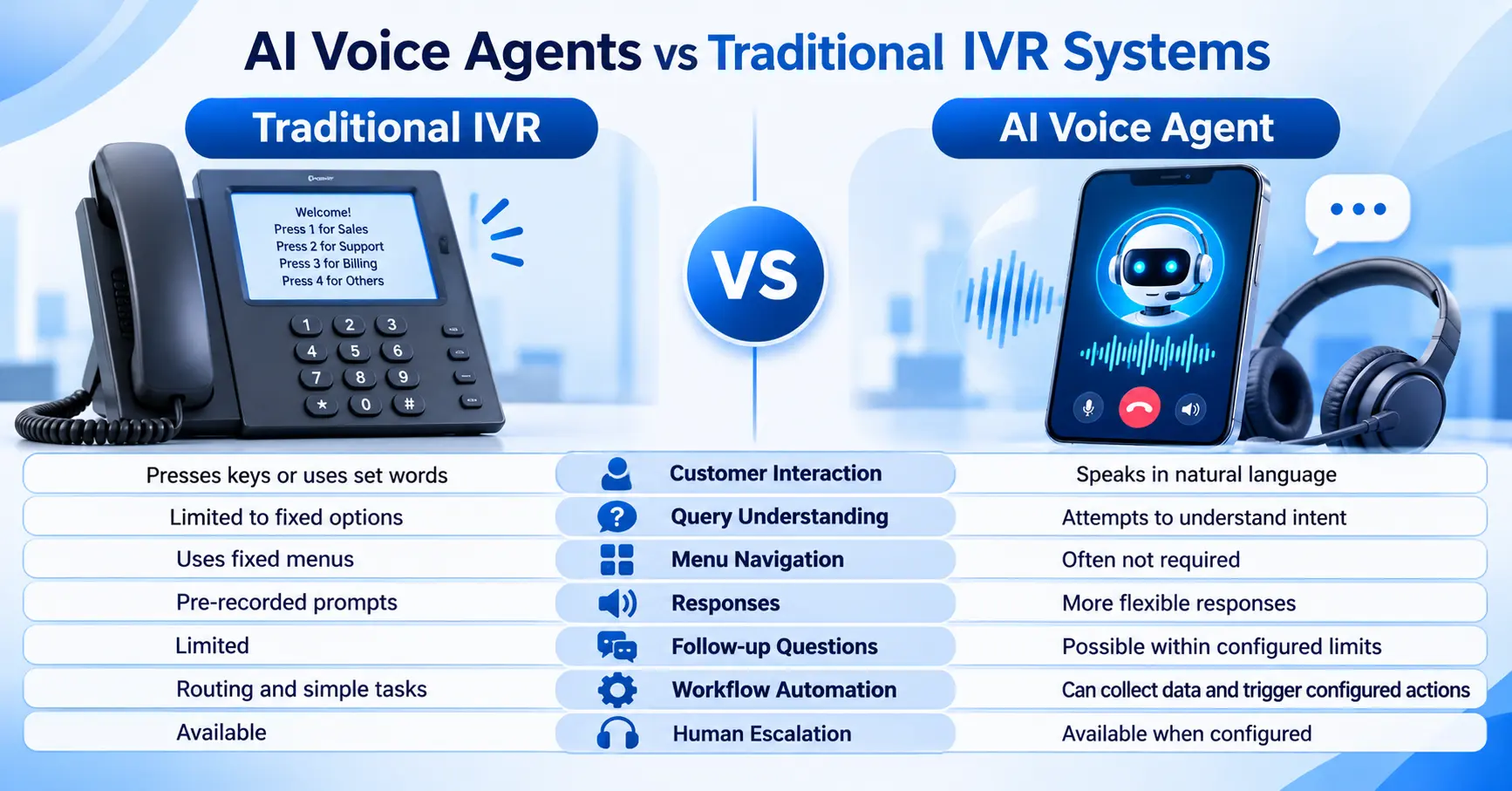
Neither is better for every business. IVR suits simple, fixed routing and is predictable. An AI voice agent suits calls with varying requests. Some businesses use both, with IVR for routing and AI for specific conversations. Mishtel’s IVR Service is one example of the fixed-menu option.
How AI Voice Agents Help Businesses Automate Customer Communication
Used for the right tasks, an AI voice agent can:
- Handle routine enquiries: Office timings, order status, or basic policy questions.
- Manage repetitive calls: Send reminders and confirmations using a fixed script.
- Support after-hours communication: Take a message or answer simple questions when the team is away.
- Improve response consistency: Every caller hears the same approved information.
- Capture customer information: Collect name, need, and preferred time during the call.
- Support sales follow-up: Call new leads and ask qualifying questions.
- Route complex queries: Pass unusual or sensitive calls to a human.
These are possible benefits. They depend on how the agent is set up and tested, and no tool can promise 100% automation or guaranteed savings.
Top Use Cases of AI Voice Agents Across Industries
| Use case | Business problem | How an AI voice agent can help | When humans step in |
| Lead qualification and follow-up | Leads go cold before anyone calls. | Calls quickly and asks set questions | Pricing talks, negotiations, complex needs |
| Appointment booking and reminders | No-shows and manual scheduling | Confirms, reschedules, and reminds | Special requests or urgent cases |
| Customer support and FAQs | Repeated basic questions | Answers from approved information | Complaints, unusual issues |
| Payment and renewal reminders | Manual follow-up takes time. | Reminds and records responses | Disputes or financial hardship |
| Order confirmation and delivery updates | Many status calls | Confirms orders and shares updates | Damaged or missing orders |
| Feedback and survey calls | Low response to forms | Asks short questions by voice | Detailed or negative feedback |
| Real estate enquiries | Enquiries arrive from many sources. | Asks about budget, location, and timing | Site visits, negotiation |
| Education and admission enquiries | Peak-season call surges | Answers common questions, collects details | Counselling and case-specific advice |
| Healthcare appointment communication | Reminders and booking take staff time. | Confirms and reschedules visits | Medical advice or sensitive information |
| E-commerce customer communication | High volumes around sales | Handles tracking and return queries | Refunds, escalations |
For regulated areas such as banking and healthcare, check what your sector rules allow and what must stay with licensed staff.
Inbound vs Outbound AI Voice Agents
Inbound agents answer calls to your business number. For example, a clinic’s agent answers after hours, takes appointment requests, and shares timings. A retailer’s agent answers “Where is my order?” using your order data.
Outbound agents place calls for a purpose. For example, a training institute’s agent calls enquiry-form leads to confirm interest, or an agent calls customers to remind them of a renewal date.
Outbound calls bring extra responsibility. You need to call only people you are permitted to call and follow calling rules (covered below).
Key Features to Look for in an AI Voice Agent Solution
Compare these features, and verify each one with the provider:
- Natural conversation: Test with real recordings of your callers.
- Language and accent support: Ask which Indian languages are handled well, not just listed.
- Inbound and outbound calling: Confirm both, if you need both.
- Customisable conversation flows: Can you define what the agent says and does?
- Call transfer to human agents: Is context passed along?
- Call records and reporting: Recordings, transcripts, and outcome reports.
- CRM or business-system integration: Which tools connect, and how?
- Data security and access controls: Who sees call data?
- Workflow customisation: Can it fit your process?
Is an AI Voice Agent Suitable for Every Business?
No. It works best for repetitive, clearly defined conversations. It is a weaker fit when:
- The call is a complaint or an emotional situation.
- The topic is sensitive, such as health or money problems.
- The request is unusual and needs judgement.
- The caller cannot be understood, or the line is poor.
A good design plan for this. The agent should recognise when to stop and transfer the call. Keep a human option available at all times.
Compliance and Responsible Use of AI Calling
Automated calls need care:
- Call only permitted contacts, and respect customer preferences.
- Follow TRAI rules on commercial calls, including preference registers and calling requirements. [VERIFY BEFORE PUBLISHING: current TRAI requirements for automated and AI-based calls.]
- Be open about the call. It is good practice to tell callers they are speaking to an AI, and to say if the call is recorded.
- Protect personal data. Follow the Digital Personal Data Protection Act, 2023, and limit who can access recordings.
- Avoid sensitive details. Do not collect more information than you need.
Requirements can change, so check the current rules and consult a legal professional if you are unsure.
How to Choose the Right AI Voice Agent for Your Business
Use this checklist:
- Business requirements: Which calls will it handle, and which stay human?
- Call volume: Share your expected volume and peaks.
- Languages: Test the languages your customers actually speak.
- Integrations: List the CRM and tools you need to connect.
- Workflow design: Who builds and updates the conversation flows?
- Security: Ask how data is stored and who can see it.
- Scalability: Check how the service handles growth.
- Reporting: Look for transcripts, outcomes, and handoff data.
- Support: Find out who helps you set up and improve the agent.
Start with a pilot. Pick one narrow use case, such as appointment reminders. Test it with a small group, listen to real calls, and review how often callers needed a human. Expand only when results are reliable. Useful measures include how many calls the agent completes, how many are transferred, and what callers say afterwards.
Where Mishtel Fits In
Mishtel Services is an Indian business communication and cloud telephony provider. According to its AI voice agents page, the service handles inbound and outbound calls, lead qualification, routine support questions, human handoff with transcript context, and call recording and logs where configured. The page says CRM and API integration depend on setup, and that language availability depends on deployment and should be confirmed for your use case.
Voice automation often sits next to other channels. A cloud call center can manage human agents, bulk voice calls can send recorded announcements, and a toll-free number gives customers one number to call. Some businesses also add WhatsApp Business for follow-ups, subject to WhatsApp’s own policies and customer opt-in. The page notes that AI voice agent pricing should be confirmed with Mishtel separately.
The Future of AI Voice Agents in Business Communication
Voice AI is likely to keep improving in speech understanding, language coverage, and connections to business systems. More businesses may use it for multilingual calls and for tasks that update records automatically. Even so, quality will depend on good design, clear boundaries, and human oversight. The strongest setups are likely to combine AI for routine calls with people for judgement and care.
Conclusion
AI voice agents can help businesses automate suitable calling tasks, answer routine queries, and follow up faster, while freeing teams for conversations that need people. Success comes from choosing the right calls, designing clear handoffs, testing with a pilot, and calling responsibly.
Looking to explore AI voice and business communication solutions? Connect with Mishtel Services to discuss your requirements.
Speech recognition turns speech into text, AI works out the intent and picks a response, and text-to-speech speaks it. Telephony connects the call, and a human takes over if needed. IVR relies on fixed menus and key presses. An AI voice agent lets callers speak freely and can handle follow-up questions within the limits you set. No. It suits routine, defined conversations. Complaints, sensitive topics, and unusual requests are better handled by people. Yes, many can run reminders, follow-ups, and lead calls. Call only permitted contacts and follow applicable calling rules. It can call new leads quickly and ask qualifying questions. It does not guarantee leads, and a person usually takes over for sales discussions. Many can, and it is an important feature to check. Ask whether context, such as a transcript, goes with the call. It depends on the product and deployment. Test the languages and accents your customers use rather than relying on a list. They can be, if call volume and repeat queries justify setup. Start with one narrow use case and a small pilot. Pricing depends on call volume, features, and the provider. Ask for a written quotation based on your use case.
How does AI voice calling work?
How is an AI voice agent different from IVR?
Can an AI voice agent handle every customer call?
Can AI voice agents make outbound calls?
Can an AI voice agent be used for lead generation?
Can an AI voice agent transfer calls to a human?
Does an AI voice agent work in Indian languages?
Are AI voice agents suitable for small businesses?
How much does an AI voice agent cost in India?