

A customer wants to call your business. But the call costs them money. So they don’t call.
That one decision — not to call — costs businesses across India thousands of leads every single month.
A Toll-Free Number removes this barrier entirely. Customers reach you for free. You pay the charge. And in return, your business gets more inquiries, stronger trust, and a professional communication identity that works across the country.
Getting set up is easier than most business owners think. This guide walks you through every step.
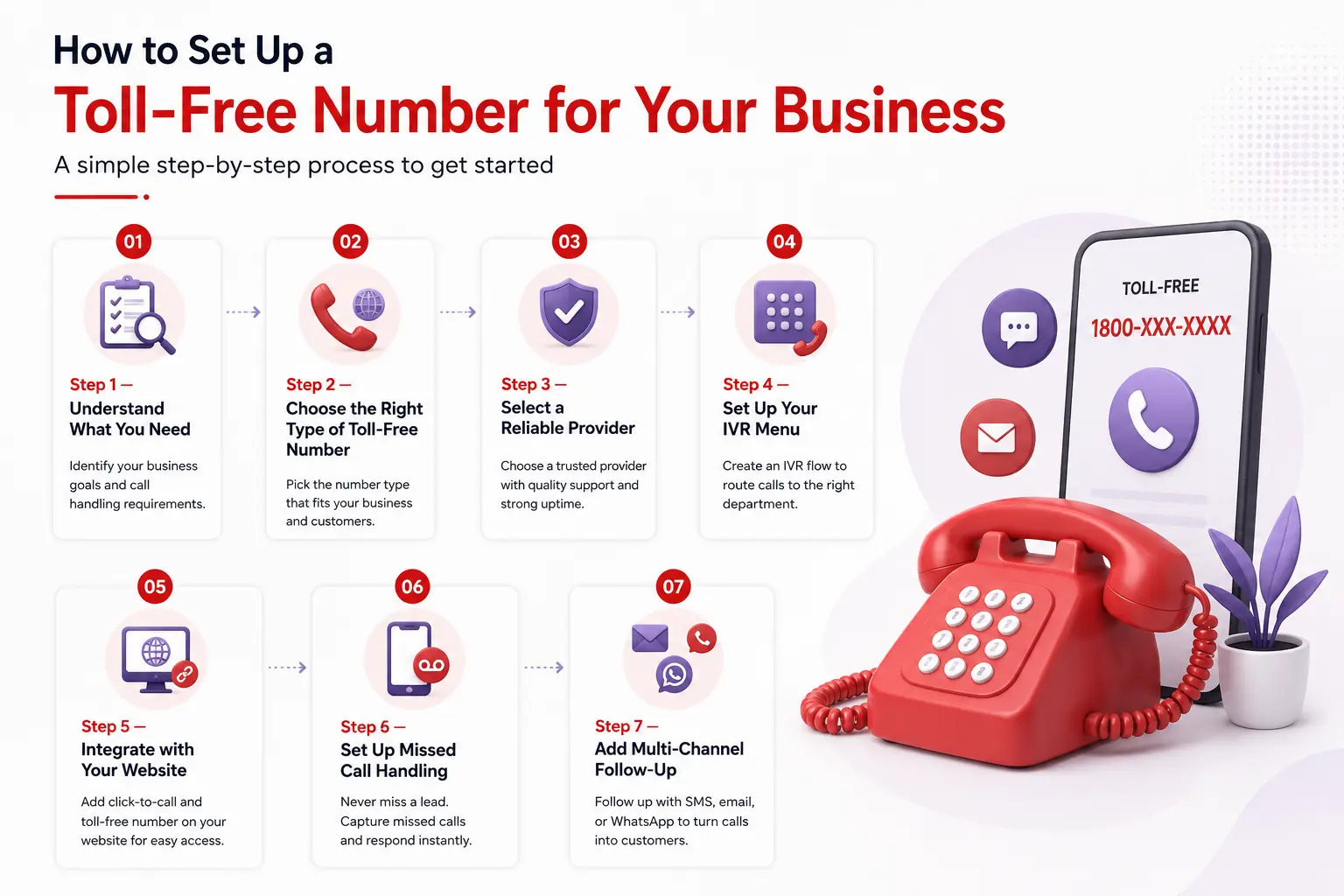
Step 1 — Understand What You Need
Before you contact a provider, get clear on what your business actually requires.
How many agents will handle calls? A small team can work with a basic single-level setup. Larger teams need intelligent routing.
What departments will callers reach? Sales, support, billing, and technical teams all need separate routing paths.
Do you need 24/7 availability? If yes, you will want an IVR Service behind your toll-free number. It handles callers automatically outside of office hours, so no inquiry goes unanswered.
What is your expected call volume? This affects which plan and infrastructure level you need from your provider.
Step 2 — Choose the Right Type of Toll-Free Number
In India, businesses typically choose between two types:
1800 numbers — Completely free for the caller. You absorb the full call cost. Best for customer-facing helplines, sales teams, and any business prioritising maximum inbound call volume.
1860 numbers — Caller pays local call rates. You pay a reduced charge. Used in banking, insurance, and utility services where some cost-sharing is acceptable.
For most businesses trying to grow inbound inquiries, 1800 is the right choice. Visit Toll-Free Number Service to explore available numbers and plans.
Step 3 — Select a Reliable Provider
Your toll-free number is only as good as the platform behind it. When evaluating providers, check for:
- Instant number activation — no long waiting periods
- Call recording and storage — for quality and compliance
- Real-time dashboard — to monitor call volumes and agent performance
- CRM integration — so agents have full caller context
- Regional language support — critical for India’s multilingual customer base
- Uptime guarantee — your line must stay active at all times
For businesses that also want to reach customers proactively between inbound calls, a Bulk Voice Call Service lets you send automated voice messages to thousands of contacts simultaneously, complementing your toll-free number perfectly.
Step 4 — Set Up Your IVR Menu
Once your number is active, the next step is configuring how calls are handled.
An IVR menu greets every caller professionally and routes them to the right department automatically. A well-designed flow sounds like this:
“Thank you for calling. For sales, press 1. For support, press 2. For billing, press 3.”
Keep your menu simple: two or three levels maximum. Callers want to reach someone quickly. Complex menus increase hang-up rates and frustrate customers.
Step 5 — Integrate with Your Website
A toll-free number displayed on your website is useful. A Click2Call Service button on your website is even better.
One tap and the visitor is connected to your team without dialing. This reduces friction for mobile users significantly and converts more website traffic into actual conversations.
Step 6 — Set Up Missed Call Handling
Some callers will hang up before connecting, especially during peak hours. Without a system in place, those leads are simply lost.
A Missed Call Service captures every caller who does not get through and automatically triggers a follow-up — by SMS, WhatsApp, or callback request. No lead falls through the cracks.
Step 7 — Add Multi-Channel Follow-Up
A toll-free number handles inbound calls. But your customers communicate across multiple channels.
For customers who prefer text, a Bulk SMS Service follow-up after a missed call or campaign keeps the conversation going on a channel they check constantly. And for Android users who respond better to visual messages, Google RCS delivers rich, branded messages with images and action buttons far more engaging than plain SMS.
Why Get Your Toll-Free Number from Mishtel?
Mishtel makes the entire setup process simple and goes well beyond just providing a number.
Instant activation. Your 1800 number is live within hours. No delays. No complex paperwork.
Smart IVR routing. Every call is directed to the right team automatically from the moment it connects. Callers never wait in the wrong queue.
Live monitoring dashboard. See call volumes, agent availability, and missed calls in real time. Make better staffing decisions based on actual data.
Complete communication platform. Your toll-free number sits inside a full stack — voice, SMS, WhatsApp, email, and RCS — all managed from one dashboard. When a campaign drives inbound calls, every channel behind your number is ready to support the volume.
Regional language support. Serve callers in Hindi, Tamil, Telugu, Marathi, and more. Language-matched greetings improve caller experience and first-call resolution.
99.9% uptime. Your business line stays active even during peak campaign periods and high call volumes.
Transparent pricing. No hidden charges. No lock-in contracts. Plans designed for every business size.
Final Thoughts
Setting up a toll-free number for your business is one of the fastest ways to increase inbound leads, build customer trust, and create a professional communication identity.
The process is straightforward: choose your number type, pick the right provider, configure your IVR, and connect it to your website and other channels.
The businesses that do this well build more customer relationships, lose fewer leads, and project a brand image that scales with them.