


Two vendors demo their platforms on the same day. Both promise high delivery, easy scheduling, and detailed reports. Both quote a rate per minute. A week later, you cannot tell which one will behave better on your busiest day, because the brochures say the same things.
That is the real difficulty in choosing a voice broadcasting service provider. Features are easy to list and hard to compare. This guide looks past the feature list. It covers what to verify, which questions most buyers miss, and how to run a small pilot before you commit. If you only need a definition, Mishtel has a short explainer on what voice broadcasting is.
What Is a Voice Broadcasting Service?
A voice broadcasting service sends a recorded or text-to-speech message to a list of phone numbers through automated calls. Three terms are used almost interchangeably:
- Voice broadcasting: The general name for sending one voice message to many people.
- OBD (Outbound Dialling): The calling method. The system dials out to your list. An OBD calling service is also called an outbound voice calling service.
- Automated voice calls: The everyday description of what the listener receives. An automated voice call service delivers them, and automated voice messaging is another name for the same idea.
All of these run on cloud telephony voice solutions, which means the calling is done by a hosted platform instead of equipment in your office. IVR is related but different. It handles the call when a person presses keys, so it is often added to a broadcast, not used instead of it.
Why Businesses Use Voice Broadcasting Solutions
Business voice broadcasting covers a wide range of everyday jobs.
| Use | Example | Point to check |
| Customer notifications | A delivery delay notice | Is the message service-related or promotional? |
| Appointment and payment reminders | A clinic visit reminder, a due-date notice | Can you trigger it from your own software? |
| Event invitations and updates | A venue change for a seminar | Can you reach people quickly on the day? |
| Feedback and surveys | “Press 1 if you are satisfied.” | Does the platform capture key presses? |
| Lead follow-ups | A call to people who filled out a form | Do you have their permission to call? |
| Promotional announcements | A festive offer to opted-in customers | Which promotional call rules apply? |
These are practical uses. A broadcast does not guarantee replies, sales, or satisfaction.
Important Factors to Consider When Choosing a Voice Broadcasting Provider
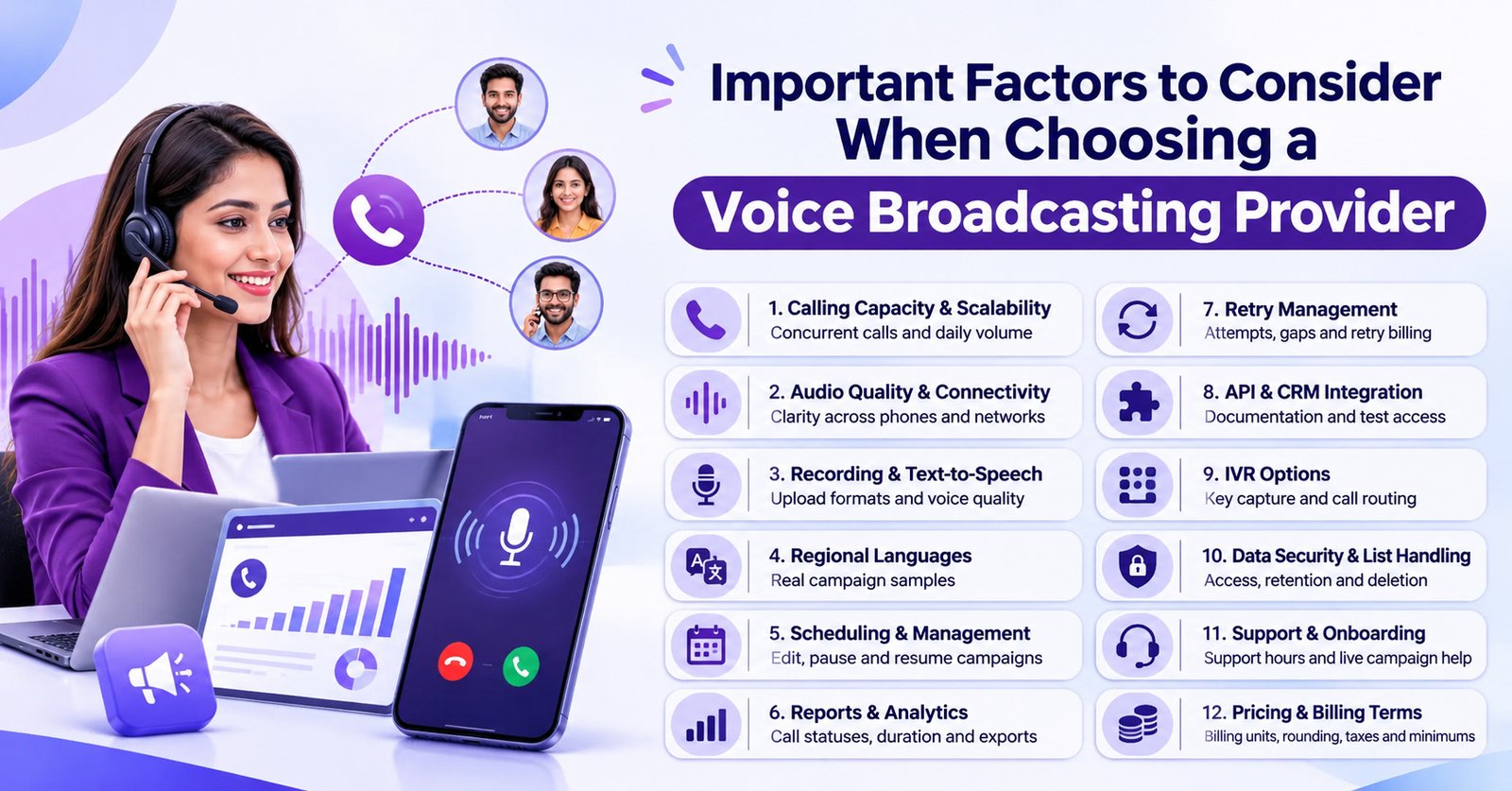
Voice broadcasting software ranges from simple diallers to full platforms. For each factor, verify the answer yourself. A statement on a website is where your questions should start, not end.
Questions Most Feature Lists Miss
These matter in practice and rarely appear on a comparison page.
- What calling route does the provider use? Some use direct operator connections; others use SIP or VoIP routes. The route can affect call quality, the number the recipient sees, and cost. Ask the provider to explain its setup in plain terms.
- What happens at peak load? A platform that works for 5,000 calls may behave differently at 500,000. Ask whether it has handled a campaign of your size.
- Which number will recipients see? A recognisable number is more likely to be answered. Ask about caller ID options and what limits apply.
- Can you export your data? Report exports and call logs help you audit a campaign and settle billing questions.
- Is there an escalation path? Ask for a named contact or process for urgent issues.
- What are the exit terms? Ask how contracts end, what happens to your lists, and how data is deleted.
How to Evaluate a Voice Broadcasting Platform Before Choosing
A short pilot tells you more than any sales presentation. Follow this process:
- Request a demo with your own use case. Ask the provider to show your scenario, not a generic one.
- Prepare a small test list. Use your team’s numbers on different mobile networks and in different cities.
- Send a sample voice message in each language. Record or generate it and listen on basic phones.
- Review the campaign report. Check that call statuses match what your team experienced.
- Check billing. Compare the usage in the report with the charge. Look at retries and call duration rounding.
- Confirm integration needs. Test one API trigger if you plan to automate.
- Test support. Raise a real question and note how fast and how clearly the team replies.
- Verify compliance. Ask how the platform supports the telecom rules for your call type.
Then score each provider. There is no best voice-broadcasting service for everyone. The best one for you scores highest on your own criteria. Here is a simple scorecard. Change the weights to match your priorities.
| Criterion | Weight | Provider A (1 to 5) | Provider B (1 to 5) |
| Audio quality and call connectivity | 25% | ||
| Reports and billing clarity | 20% | ||
| Capacity and scalability | 15% | ||
| Language and recording options | 10% | ||
| API and integration | 10% | ||
| Support and onboarding | 10% | ||
| Price for your volume | 10% |
Do not let price alone decide. A lower rate with unclear billing can cost more.
Voice Broadcasting vs Traditional Manual Calling
| Area | Voice broadcasting | Manual calling |
| Scalability | Large lists in one campaign | Limited by team size |
| Campaign management | Scheduling, retries, and pause controls | Call sheets and team leads |
| Consistency | Same message every time | Varies by caller |
| Reporting | Campaign-wide call statuses | Agent notes |
| Operational effort | Setup, then monitoring | One agent per conversation |
| Suitability | Reminders, notices, and short announcements | Complaints, negotiation, and sensitive topics |
Manual calling is better when a customer needs advice, is upset, or needs to make a decision. Many teams broadcast first and let agents handle the replies, using a cloud call center.
Which Businesses Can Benefit from Voice Broadcasting?
- Banking and financial services: Due-date reminders. Follow sector rules and never ask for card details on a call.
- Healthcare and clinics: Appointment and health-camp reminders. Keep sensitive details out of the message.
- Education and training institutions: Fee reminders, exam timings, and class changes.
- Retail and e-commerce: Order and delivery notices and offers to opted-in customers.
- Logistics and delivery: Pickup and delivery-window notices.
- Real estate: Site visit confirmations and event invitations.
- Customer support and service organisations: Service visit confirmations and outage notices.
How to Compare Voice Broadcasting Prices
Online listings quote per minute, per hour, per month, or per year. These numbers cannot be compared directly. Convert each quote into the cost of one campaign using your own volume, message length, and the provider’s billing unit.
Mishtel publishes slab-based voice call pricing on its pricing page. It describes the rates as prices per single unit delivery, with a unit of 30 seconds. Ask Mishtel what counts as a delivery, how longer messages are billed, and whether taxes apply. For a quote based on your numbers, see Mishtel’s guide on choosing a bulk voice call service for your business, which includes a requirements worksheet.
Planning a voice broadcasting campaign? Share your calling volume, message length, languages, and integration needs with Mishtel to request a customised quotation.
Responsible Calling and Compliance Checks
Commercial calls in India follow TRAI rules. According to recent TRAI clarifications, 140-series numbers are meant for promotional calls by registered telemarketers. The 1600 series is for service and transactional calls by certain regulated entities. A call that mixes promotional content into a service message is treated as promotional.
Call only people you are permitted to call, keep consent records, and honour preference registers such as DND. Rules change, so read TRAI’s commercial communications regulations and check current directions before each campaign. This is general information, not legal advice.
Why Consider Mishtel for Voice Broadcasting Solutions?
Mishtel is an Indian business communication and cloud telephony provider. Its voice solutions page describes outbound dialling (OBD) for promotions, lead generation, customer service, surveys, and follow-ups. It also lists Playback IVR, call forwarding, click-to-call, missed call, toll-free numbers, and conference calling.
According to its Bulk Voice Call Service page, the service includes automated voice broadcasting with pre-recorded messages. You can use your own recording or text-to-speech. The page also lists multiple language support, scheduled campaigns, and real-time delivery reports. It adds retry logic for unanswered calls, a campaign dashboard, API integration, and custom caller ID support. The page says DND filtering is available. Confirm which features are included in your plan.
If your campaign needs callers to respond, an IVR Service can add a menu. Mishtel’s website also states that the company is VNO (Virtual Network Operator) approved by the Department of Telecommunications, Government of India. That is company information, and it does not settle every compliance question for a campaign.
Use the pilot steps above with Mishtel as you would with any provider. Share your calling volume, campaign requirements, language preferences, and integration needs, and ask the team to walk you through a test.
Final Thoughts
Choosing a voice broadcasting service is easier when you stop comparing brochures and start comparing behaviour. Verify capacity and billing in writing, ask the questions most feature lists miss, and run a small pilot with your own numbers. Score each provider on the same criteria, and check the telecom rules for your call type.
Looking for a voice broadcasting service for your business? Contact Mishtel Services to discuss your requirements and request a customised quotation.
You upload a permitted contact list and a voice message, set a schedule, and start the campaign. The platform dials each number, plays the message, and records call statuses. OBD (Outbound Dialling) is the calling method. Voice broadcasting is the use of OBD to send one message to many people. In practice, the terms are often used together. For delivery notices, appointment and payment reminders, event updates, and surveys. Add IVR if you want recipients to respond by pressing keys. Look for capacity, audio quality, language options, scheduling, call reports, retries, API options, security, and support. Test them with your own numbers. It depends on volume, message length, billing unit, features, and integration. Online quotes use different units, so convert them into campaign cost. Mishtel lists slab rates on its pricing page. Yes, if you send regular notices to a permitted list. Start with a small campaign and check the reports and billing before you scale up. Check capacity, audio quality, languages, reports, billing terms, support, and compliance help. Run a pilot, and score each provider on the same criteria.
How does voice broadcasting work?
What is the difference between voice broadcasting and OBD calling?
How can businesses use automated voice calls?
What features should a voice broadcasting platform offer?
How much does a voice broadcasting service cost in India?
Is voice broadcasting suitable for small businesses?
What should businesses check before choosing a voice broadcasting provider?