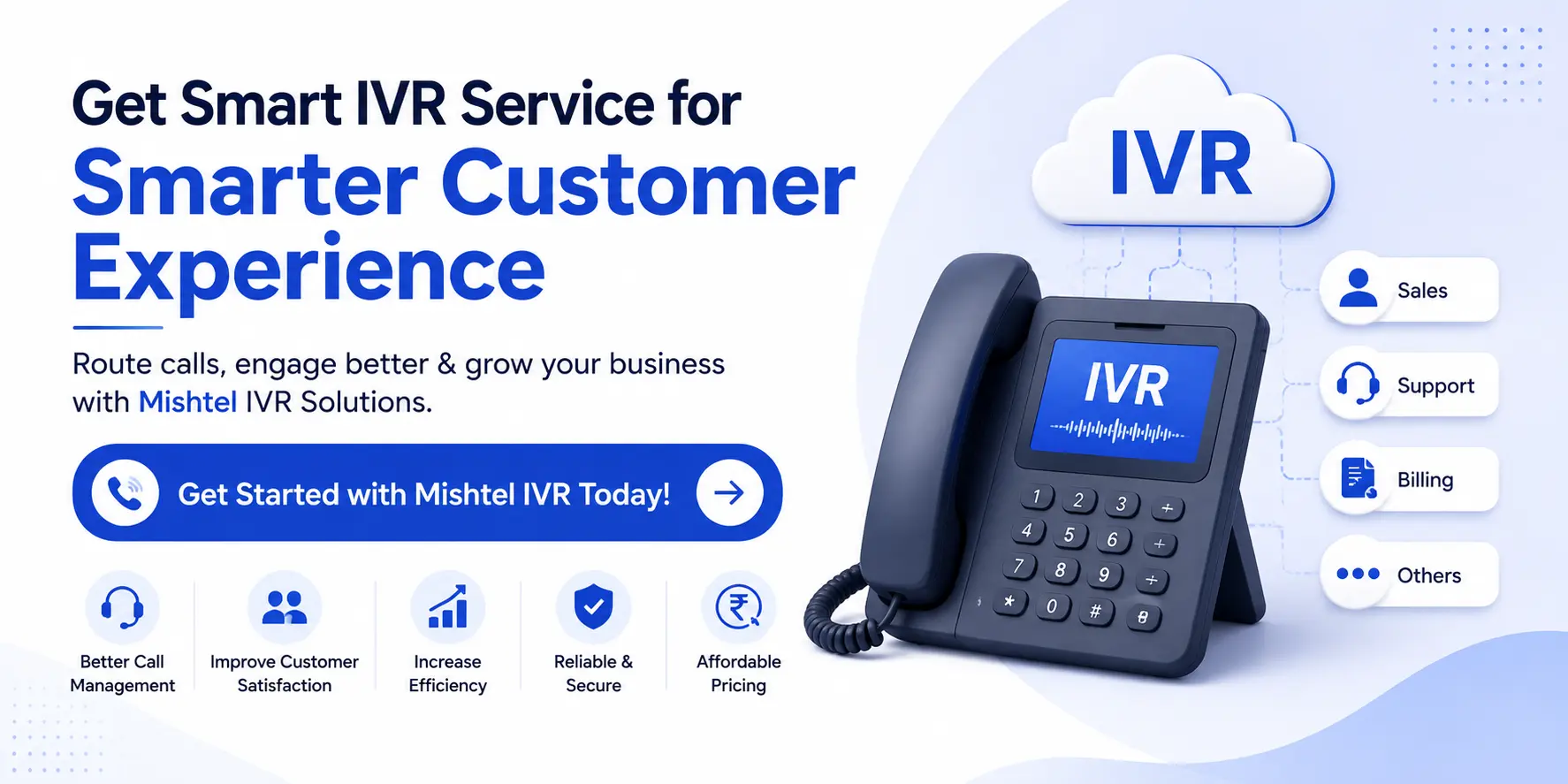



Ever called a company and heard — “Press 1 for Sales, Press 2 for Support”?
That is an IVR system in action. And what sounds like a simple phone menu is actually one of the most powerful customer communication tools a business can deploy.
In 2026, IVR Service is no longer just for large enterprises. Businesses of every size — from startups to hospitals to NBFCs are using it to handle calls smarter, reduce costs, and deliver better customer experiences.
This guide explains exactly what an IVR service is, how it works, and why your business needs one.
What Is an IVR Service?
IVR stands for Interactive Voice Response. It is an automated telephony system that interacts with callers, collects their input through keypad presses or voice commands, and routes them to the right agent or department automatically.
When a customer calls your business, the IVR greets them, presents a menu of options, and directs their call without any human intervention. It can also provide automated responses to common queries — account balance, order status, business hours — without involving an agent at all.
For businesses managing a high volume of inbound calls alongside their IVR, pairing it with a Cloud Call Center platform gives supervisors complete visibility — live call queues, agent performance, and call recordings — all in one dashboard.
How Does an IVR Service Work?
The process is fast and automatic. Here is what happens when a customer calls your IVR-enabled business number:
Step 1 — The caller dials your number. Your IVR system answers instantly. A pre-recorded greeting plays.
Step 2 — The menu presents options. “For billing, press 1. For technical support, press 2.” The caller selects using their keypad or speaks their choice.
Step 3 — The call gets routed. Based on the input, the system directs the call to the correct department, agent, or automated response — instantly.
Step 4 — The interaction is logged. Every call is recorded, tagged, and tracked. Duration, caller ID, menu selections, and outcomes are all stored for reporting.
The entire process runs without any manual effort — and works 24 hours a day, seven days a week.
Types of IVR Systems
Single-Level IVR — One menu with a few options. Simple and fast. Best for small businesses with straightforward call flows.
Multi-Level IVR — Multiple layers of menus. Callers navigate to a specific department or service. Ideal for large organisations with complex call routing needs.
Outbound IVR — The system initiates calls to customers automatically — for reminders, alerts, or surveys. For businesses running large outbound campaigns, combining outbound IVR with a Missed Call Service captures every customer who hangs up and triggers an automatic follow-up.
Key Benefits of IVR Service for Indian Businesses
Handles High Call Volumes Without Extra Staff
Your team cannot answer every call simultaneously. An IVR service handles multiple calls at once — automatically. No queue overflow. No missed calls during peak hours.
Routes Every Caller to the Right Person
Being transferred multiple times is one of the most frustrating experiences for any customer. IVR gets them to the right agent on the first attempt — improving satisfaction and reducing average handle time significantly.
Works Around the Clock
Your office closes. Your IVR does not. Callers access information, leave messages, or get routed to on-call support at any hour — without any staff involvement.
Reduces Operational Costs
Automating routine call handling means your agents spend less time on repetitive tasks and more time on meaningful customer conversations. This directly lowers your cost per interaction.
Gives You Real Data
Every call generates data — peak hours, common menu selections, call duration, agent performance. Use this data to improve staffing decisions and customer experience continuously.
Where IVR Service Is Used in India
Banking and Finance — Balance inquiries, loan status updates, EMI reminders, and fraud alerts — all automated. For customers who want to connect with a specialist, the IVR routes them to the right team instantly.
Healthcare — Appointment booking, prescription reminders, and patient support lines. For clinics that also want patients to connect directly from their website, a Click2Call Service button makes one-tap calling possible without dialing.
E-Commerce — Order status, return requests, delivery updates, and complaint routing. IVR handles the routine queries so agents focus on complex issues.
Education — Admission inquiry routing, exam result information, and fee reminder lines — all automated and tracked.
Real Estate — Property inquiry routing and lead management. Callers press a key to get more details about a specific property or connect with a sales agent directly.
Telecom and Utilities — Account management, bill payment, and technical support routing — at any scale.
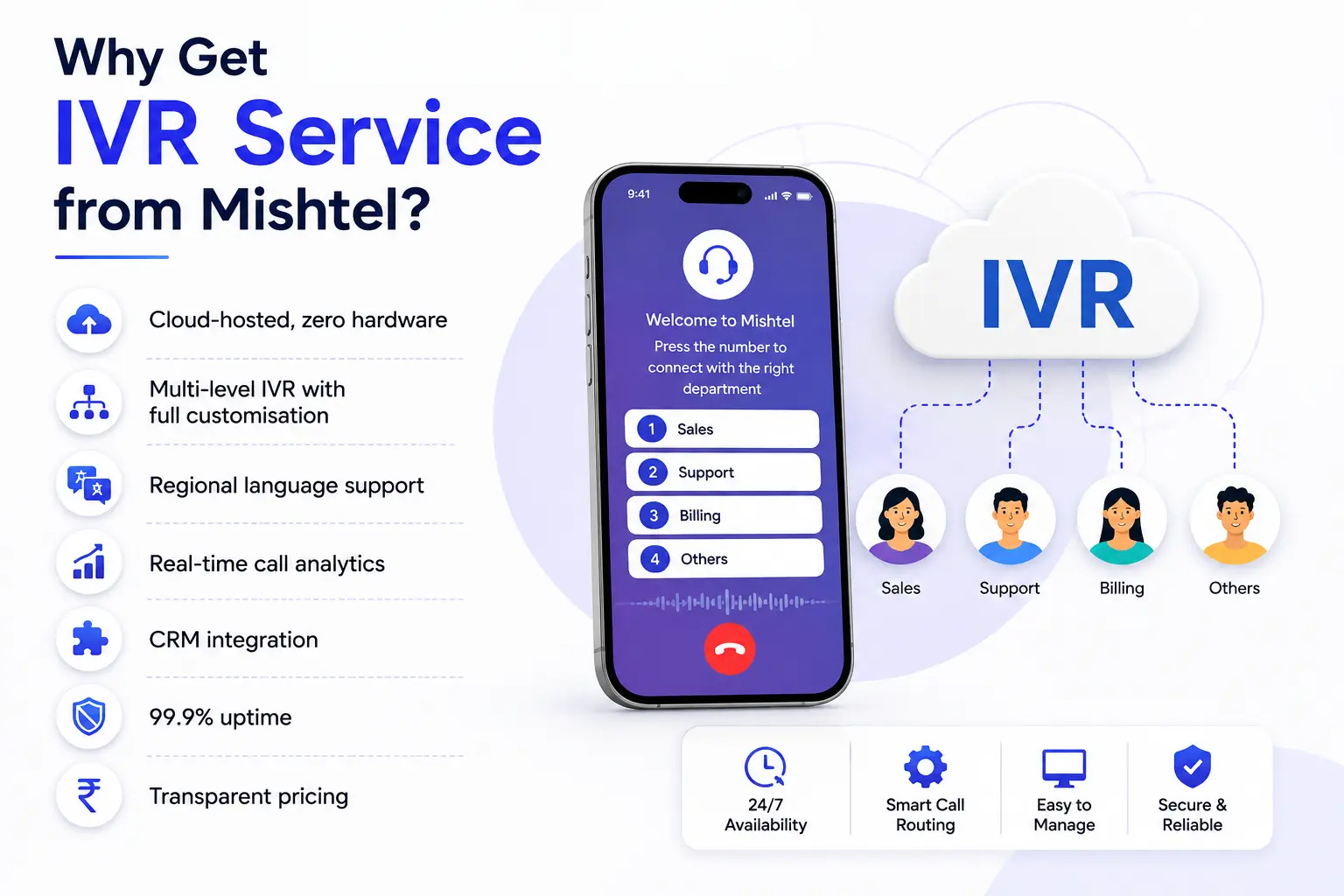
Why Get IVR Service from Mishtel?
There are many IVR providers in India. Here is what makes Mishtel worth choosing:
Cloud-hosted, zero hardware. Your IVR runs entirely on the cloud. No servers to buy. No equipment to maintain. Set up in minutes and manage everything from a simple dashboard.
Multi-level IVR with full customisation. Build simple or complex call flows route by department, time of day, caller location, or agent availability. You are in full control.
Regional language support. India is multilingual. Mishtel’s IVR supports Hindi, Tamil, Telugu, Marathi, Bengali, and more, so every caller hears your brand in the language they prefer.
Real-time call analytics. Track every call live. Monitor agent performance, call volumes, and missed calls from a single dashboard. Make staffing and routing decisions based on actual data.
CRM integration. Mishtel connects with leading CRM platforms. Agents receive full caller context before they pick up, which leads to faster, better conversations.
99.9% uptime. Your customer-facing phone line cannot afford downtime. Mishtel’s infrastructure is built for reliability even during high-volume periods.
Transparent pricing. No hidden charges. Choose a plan that fits your call volume and scale up when you are ready.
Final Thoughts
An IVR service is not just a call management tool; it is a customer experience upgrade. It reduces wait times, eliminates misdirected calls, cuts operational costs, and keeps your business accessible around the clock.
In 2026, customers expect fast, frictionless communication every time they call. An IVR system — built right — delivers exactly that.