


A school needs to tell 3,000 parents that tomorrow’s timing has changed. A clinic wants to remind patients about appointments. A retailer must share a delivery update with customers across several cities. Calling each person one by one would take days, and each caller might say something slightly different.
A Bulk Voice Call Service is one way to handle this. It lets a business send the same recorded or automated message to many people in a short time. This guide explains how it works, where it fits, how to choose a provider, and how to use it responsibly.
What Is a Bulk Voice Call Service?
A bulk voice call service is a platform that places automated phone calls to a list of contacts and plays a pre-recorded or computer-generated voice message. It is also called bulk voice broadcasting or an automated voice call service.
Businesses use it when the same message needs to reach many people, and a spoken message works better than text. Features vary between platforms, so always confirm what a provider offers.
How Does Bulk Voice Calling Work?
Most campaigns follow five steps:
- Prepare the message. Record your own audio or create one from text.
- Upload or select the contact list. Use only contacts you are permitted to call.
- Configure the campaign. Choose options such as language, caller ID, and retries, where available.
- Schedule or start the calls. The system dials the numbers and plays the message when someone answers.
- Review reports. Check delivery status and other call details after the campaign.
Not every platform offers the same options, so compare them against your needs.
Why Do Businesses Use Bulk Voice Call Services?
The main reasons are practical:
- Efficiency: One campaign reaches many customers without a team dialling each number.
- Consistency: Every listener hears the same information.
- Time savings: Staff can focus on conversations that need a human.
- Reminders and updates: Dates, deadlines, and changes reach people quickly.
- Customer engagement: A voice message can feel more direct than a text or email.
- Scale: Large lists can be managed from one dashboard.
These are possible benefits. No voice campaign can guarantee sales, conversions, or replies. Results depend on your message, your list, and your timing.
Common Business Uses of Bulk Voice Calls
Typical uses include:
- Promotional announcements and offers
- Appointment reminders
- Payment due reminders
- Order and service updates
- Event announcements
- Educational announcements
- Customer feedback requests
- Service notifications and operational updates
It helps to separate two types of calls. Service-related calls share useful information with existing customers, such as delivery updates or appointment reminders. Promotional calls advertise products or offers. Rules for the two types can differ, and promotional calls are often subject to stricter requirements. Check current telecom rules for your case before you send either type.
For short text updates, many businesses add Bulk SMS next to voice calls. The right channel depends on the message and the audience.
Key Features to Look for in a Bulk Voice Call Service
These are general features worth comparing across providers:
- Voice message recording or upload: Can you use your own audio or text-to-speech?
- Contact list management: Can you upload, group, and update lists easily?
- Campaign scheduling: Can you choose the date and time?
- Call status reports: What delivery and call data do you receive?
- Retry options: Can the system try again when calls go unanswered?
- Call routing or interactive options, if supported: An IVR service lets callers press keys to choose options.
- Integration options, if available: Ask about API access if you want to automate campaigns.
- Campaign management and technical support: Check how easy it is to run campaigns and get help.
Bulk Voice Calls vs Manual Calling
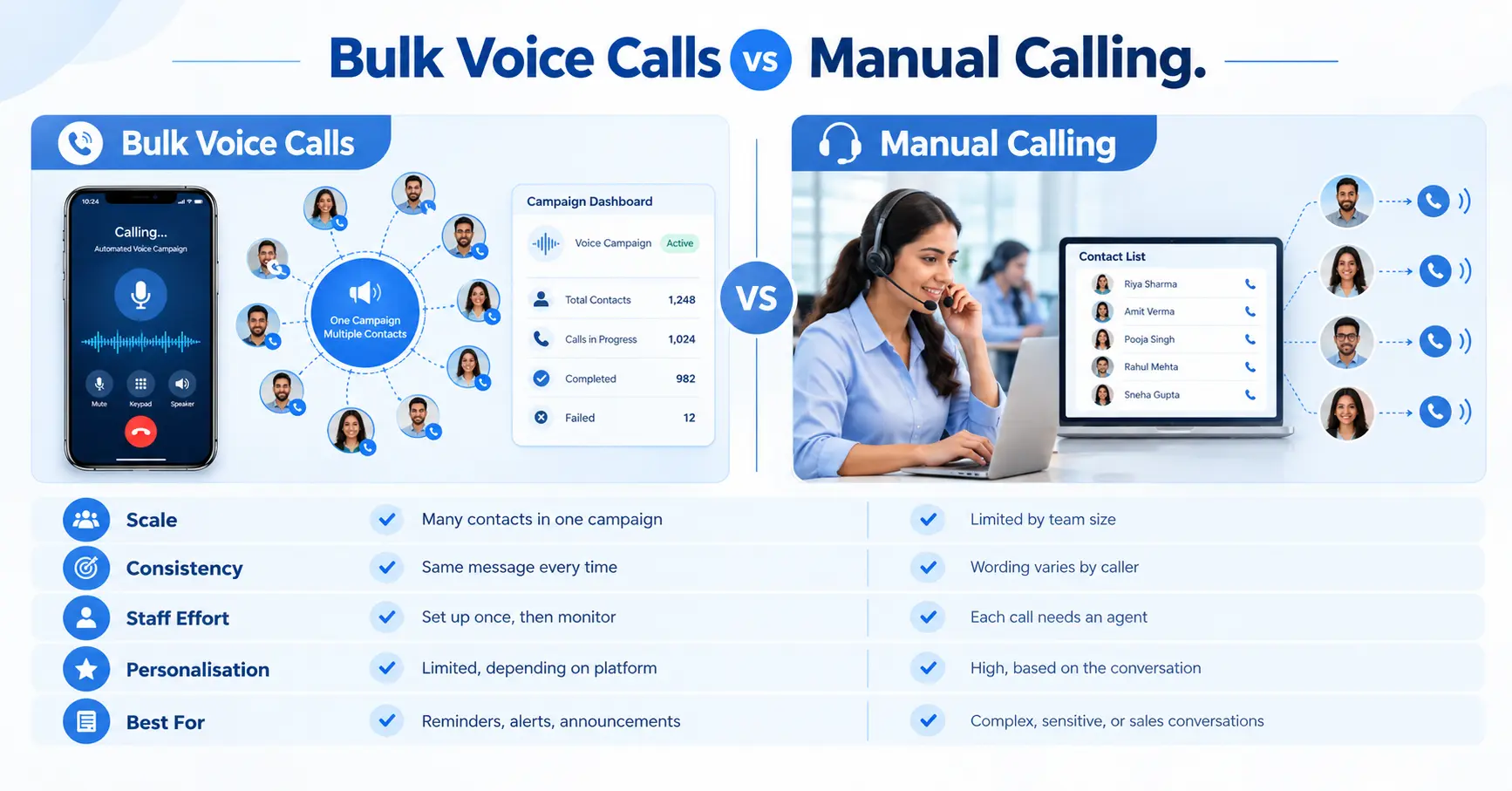
Automated calling does not replace every human conversation. A caller who needs advice or has a complaint should reach a person. For businesses that want automated calls that can hold a basic conversation, an AI voice agent is a different option, and its suitability depends on the use case.
Which Industries Can Benefit from Bulk Voice Call Services?
- Education: Notices about timings, exams, or events to parents and students.
- Healthcare: Appointment and check-up reminders, with care taken over privacy.
- E-commerce: Order status and delivery updates.
- Banking and financial services: Due date and service reminders, within sector rules.
- Hospitality: Booking confirmations and event information.
- Retail: Sale announcements to customers who agreed to hear about them.
- Other service businesses: Appointment confirmations and service visit updates.
Each business has its own needs and rules, so adapt these examples to your situation.
How to Choose the Right Bulk Voice Call Service Provider
Ask these questions before you decide:
- Requirements and volume: Can the provider handle your calling volume?
- Audio quality and call performance: Can you test a sample call?
- Reporting and controls: What data can you see after a campaign?
- Scalability: Can it grow as your list grows?
- Technical support: When and how can you reach the team?
- Pricing transparency: What is included, and what costs extra?
- Privacy, consent, and compliance: How does the provider support responsible calling?
Share your expected volume and use case, then ask for a clear written quotation.
Responsible and Compliant Bulk Voice Calling
Reach is useful only when people expect and welcome the calls. Good practice includes:
- Use contact lists properly. Call only people you are permitted to call.
- Get required permissions. Keep a record of how each contact agreed.
- Respect preferences. Remove people who ask to stop.
- Follow telecom rules. TRAI’s regulations on commercial communication cover commercial voice calls and messages. Read the TCCCPR text and check current requirements for promotional and service-related calls.
- Keep messages clear. State who is calling and why.
Rules change, and this is general information rather than legal advice. If you are unsure, consult a legal professional.
How Mishtel Can Support Business Communication
Mishtel is an Indian business communication and cloud telephony provider. According to its service page, Mishtel’s bulk voice call service lets businesses send pre-recorded voice messages to many contacts, with options to upload their own recording or use text-to-speech. The page also lists multiple-language support, scheduled campaigns, real-time delivery reports, retries for unanswered calls, a campaign dashboard, API integration, and custom caller ID support. It states that DND filtering is available.
Features and setup can vary by requirement, so the best step is to share your use case. Useful details include your approximate call volume, message type, language needs, and the reports you want. You can also explore the wider range of services at Mishtel, such as a Cloud Call Center for customers who call back.
Contact the Mishtel team to discuss your requirements and see what fits.
Conclusion
A bulk voice call service can help businesses send reminders, updates, and announcements to many people quickly and consistently. It works best for clear, useful messages sent to the right audience, with proper permissions and a plan for customers who call back.
Compare features, reporting, support, and compliance before you choose. When you are ready, explore Mishtel’s bulk voice calling options or contact the team.
You prepare a message, upload a permitted contact list, and set up the campaign. The system dials each number and plays the message when answered. You can then review reports. Schools, clinics, retailers, e-commerce companies, financial service providers, and other service businesses can use it. The right use depends on your audience and the rules that apply. Many platforms support scheduling by date and time. Mishtel’s service page says campaigns can be scheduled. Confirm the options for your plan. Check call quality, reporting, scalability, support, pricing clarity, and how the provider handles consent and compliance. Test with a small campaign first. Yes, these are common uses. Keep messages short and clear, and confirm which rules apply to service and promotional calls. Contact the Mishtel team and share your use case, call volume, and language needs. They can explain the available options.
How does a bulk voice call service work?
Which businesses can use bulk voice calling?
Can bulk voice calls be scheduled?
What should businesses check before choosing a provider?
Is bulk voice calling suitable for reminders and announcements?
How can a business get started with Mishtel?