

Every missed call is a missed customer. That’s the reality most businesses learn the hard way.
A regular mobile or landline number puts the cost of the call on the customer. Many hesitate to dial, especially for enquiries that might take a few minutes to resolve.
A Toll-Free Number Service removes that barrier completely. The business pays for the call, not the caller — and that one change can noticeably increase how many customers actually reach out.
This guide explains what a toll free number is, how it works, and why businesses across India are relying on it in 2026.
What Is a Toll Free Number?
A toll free number is a dedicated business number, usually starting with 1800, where the calling cost is billed entirely to the business instead of the customer. It’s not just a phone line — a proper Toll-Free Number Service includes call routing, recording, and reporting, so every call becomes useful business data instead of just a conversation.
For businesses that still depend only on a basic IVR Service without any centralized number, adding a toll free number is often the first real upgrade to how calls are handled.
Toll Free Number vs Regular Business Number
The difference shows up the moment a customer decides whether or not to call.
Regular business number:
- Costs the caller money
- Looks like a personal or local number
- Hard to scale across multiple agents
- No built-in call analytics
- Feels less professional to new customers
Toll free number:
- Completely free for the caller
- Builds instant brand credibility
- Easily routes calls to multiple agents or departments
- Comes with detailed call reports
- Works the same way across every state or region
This shift usually means more inbound calls and a noticeably more professional first impression for anyone contacting your business.
How a Toll Free Number Works
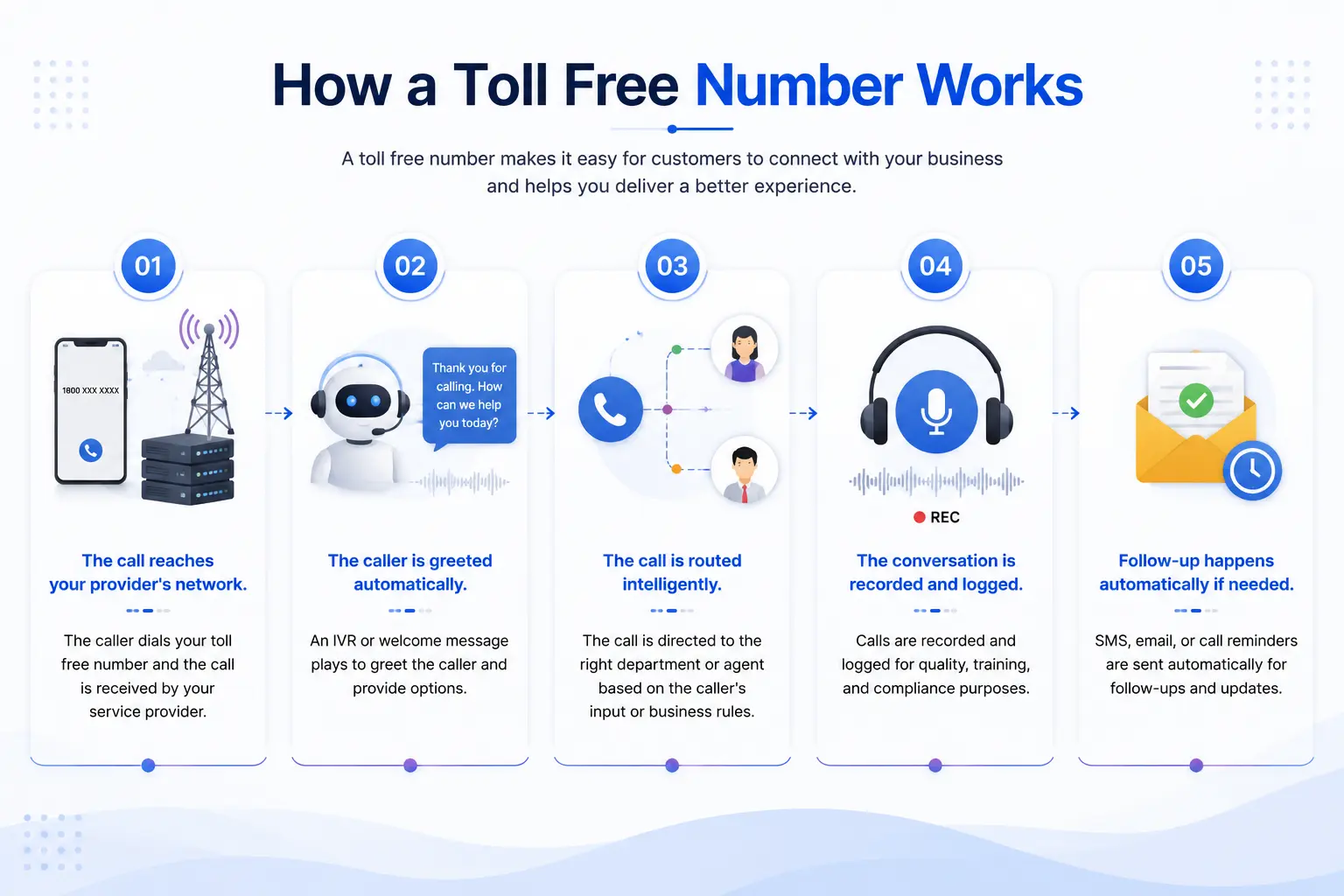
When a customer dials your toll free number, here’s what actually happens:
Step 1 — The call reaches your provider’s network. There’s no separate hardware needed on your end; the number is fully cloud-managed.
Step 2 — The caller is greeted automatically. An IVR menu offers simple options, so the customer can choose the right department in seconds.
Step 3 — The call is routed intelligently. Based on the caller’s selection or agent availability, the system sends the call to the right team.
Step 4 — The conversation is recorded and logged. This gives your team a searchable record for training, quality checks, or dispute resolution.
Step 5 — Follow-up happens automatically if needed. A Missed Call Service ensures unanswered calls are returned, and a Click2Call Service on your website lets the same customer reconnect with one tap on their next visit.
Key Features
Multi-Agent Call Routing: Distributes incoming calls across available agents, so no customer waits too long or gets a busy tone.
Call Recording and Analytics: Every call is stored and analyzed, giving managers real visibility into call quality and customer concerns.
Virtual Number, No Hardware: The entire setup runs in the cloud, often managed through Cloud Call Center, where supervisors can track live calls and agent performance from one screen.
Scalable Across Locations: Works the same whether your team is in one office or spread across cities, with no extra setup per location.
Industry Use Cases
Healthcare — Manages appointment bookings and patient queries without overwhelming front-desk staff during busy hours.
E-Commerce — Handles order support and returns at scale, often paired with a Bulk SMS Service to send order confirmations right after the call.
BFSI — Manages high call volumes for account queries and alerts, working alongside a Bulk Voice Call Service for outbound reminders and updates.
Real Estate — Captures buyer enquiries from ads and listings, with an Google RCS following up with property details right after the call ends.
Pricing
Pricing for a toll free number usually depends on call volume, the number of connected agents, and add-ons like IVR or call recording. Some providers charge a flat monthly fee, while others bill per minute of usage. It’s worth asking upfront which features come bundled versus billed separately, since this can noticeably change your final cost.
Why Get a Toll Free Number from Mishtel?
There are several providers in this space. Here’s what makes Mishtel different:
Quick activation. Your toll free number is set up and live within a few working days, with minimal paperwork on your side.
Complete communication stack. Mishtel bundles IVR, call recording, and a Bulk SMS Service together, so you’re not managing multiple vendors for one function.
No missed enquiries. Paired with a Missed Call Service, every customer attempt gets a response, even after business hours.
Real support, not just automation. A dedicated team is available whenever you need help with setup or troubleshooting.
Clear, upfront pricing. No hidden charges, with plans that scale as your call volume grows.
If your business is ready to make calling in easier for customers, it’s worth reaching out to Mishtel for a demo of the Toll-Free Number Service.
Final Thoughts
A toll free number is no longer just a nice-to-have — it’s become a basic expectation for businesses that want to be taken seriously. In 2026, it’s one of the simplest ways to reduce friction for customers and build lasting trust from the very first call.
If your business is still relying on a regular number, this is a good year to change that.