


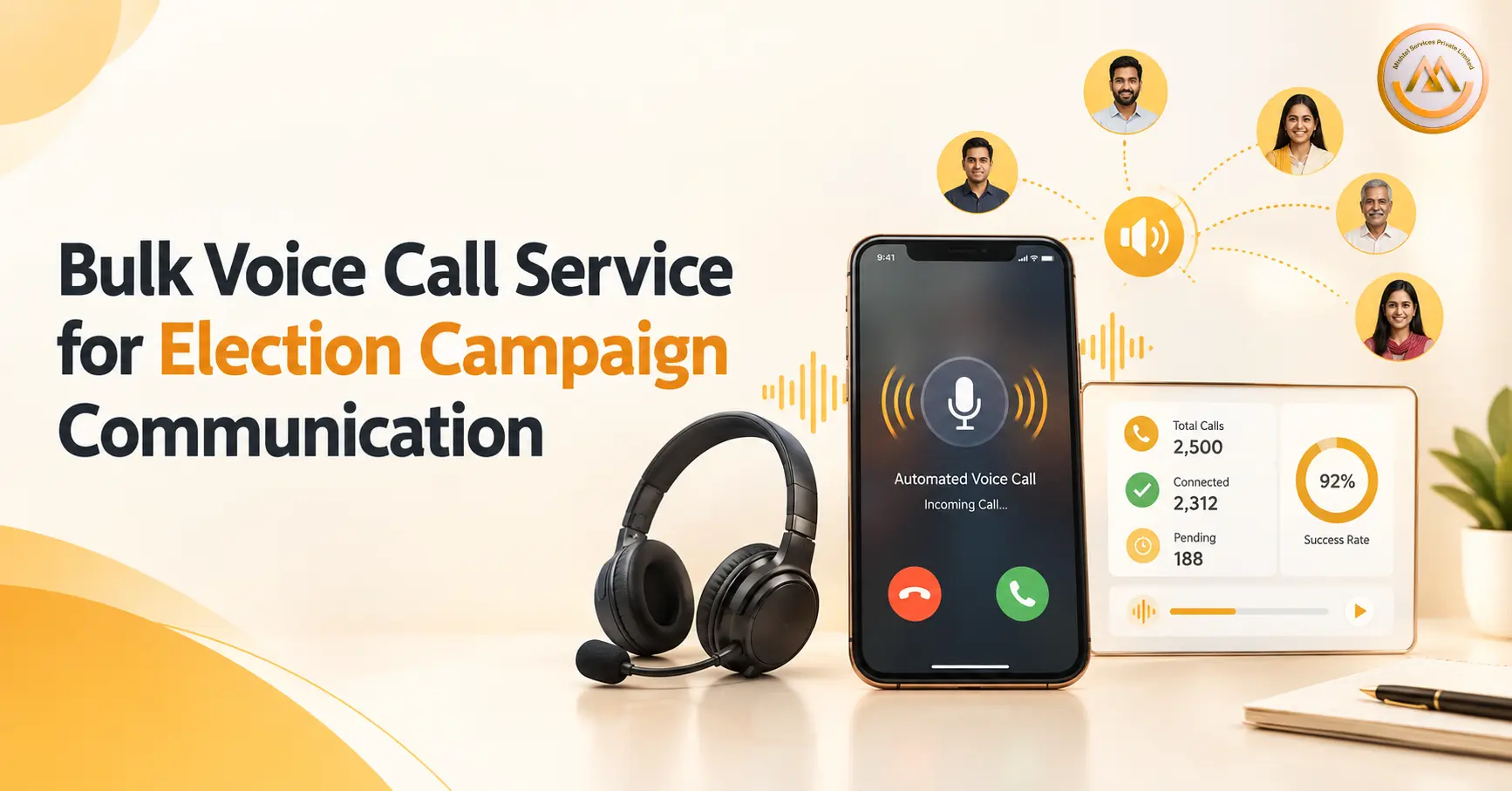
Election periods leave little room for delay. A meeting moves, a venue changes, or volunteers need new instructions. Posters and word of mouth cannot always keep up. Teams need a way to share clear information with many people at the same time.
A Bulk Voice Call Service is one option. It delivers a recorded audio message to many phone numbers through automated outbound calls. This guide explains how it works, what to check before choosing a provider, and how teams in Uttar Pradesh, Punjab, Goa, and Uttarakhand can plan responsibly.
A note on timing: as of October 2026, the Election Commission of India (ECI) has not announced the poll schedule for these states. Media reports point to polls around February–March 2027, but only official ECI notices can confirm dates.
What Is a Bulk Voice Call Service?
A bulk voice call service sends a pre-recorded message to a large list of phone numbers at once. When a person answers, the message plays. It is also called a voice-broadcasting service or automated outbound calling.
The process usually looks like this:
- Prepare an approved audio message.
- Configure the calling schedule and the list of eligible recipients.
- Set up the campaign on the service platform.
- Deliver calls according to the permitted configuration.
- Review the delivery and campaign reports.
Exact features depend on the provider and your setup, so confirm details before you start.
How Bulk Voice Calls Can Support Election-Related Communication
Voice calls suit short, clear announcements. Appropriate uses include:
- Event and meeting announcements: Share the date, time, and place.
- Schedule and venue updates: Tell registered attendees about changes quickly.
- Volunteer coordination: Send duty details and reporting times to your team.
- Public information announcements: Share neutral, factual notices.
- Administrative reminders: Remind participants about documents or deadlines.
- Communication with registered participants: Update people who have signed up.
Voice works well for people who prefer listening to reading. For text-based updates, many teams add Bulk SMS Service alongside calls. If you want callers to choose options or request a callback, an IVR Service can add a simple voice menu.
This article focuses on clear information. It does not cover voter persuasion or audience profiling.
Key Features to Check Before Choosing a Voice Broadcasting Service
Compare providers on these points, and verify each one directly:
- Audio upload and playback quality: Poor audio makes a message hard to follow. Check: Can you upload your own recording and preview it?
- Campaign scheduling: Timing matters for announcements. Check: Can you schedule by date and time?
- Call delivery reports: Reports show what happened after the campaign. Check: What data do you get, and can you export it?
- Campaign status monitoring: You may need to track progress. Check: Can you view live status?
- Call volume and capacity: Large lists need enough capacity. Check: What limits apply, and how are peaks handled?
- Language and audio requirements: People respond better in familiar languages. Check: Which languages are supported?
- Technical support: Delays are costly in a tight schedule. Check: When and how can you reach support?
- Data security and access controls: You will upload personal numbers. Check: Who can access your lists and reports?
Bulk Voice Call Communication in Uttar Pradesh, Punjab, Goa, and Uttarakhand
Teams searching for a bulk voice call service in Uttar Pradesh, Punjab, Goa, or Uttarakhand often ask the same question: what changes from state to state? Mostly it comes down to language, audio clarity, call volume, and timing. These are general planning points, not market claims.
| State | Communication planning considerations | Example of a general informational use case |
| Uttar Pradesh | Large geography and many local languages and dialects; plan for high call volume and phased schedules | Announcing a meeting schedule to registered volunteers across districts |
| Punjab | Audio clarity and language choice for local audiences; confirm message timing | Sharing venue details for a public information session |
| Goa | Smaller areas, but multiple languages in daily use, such as Konkani, Hindi, and English | Sending reminders to registered event participants |
| Uttarakhand | Mobile coverage can be uneven in some areas; consider retry settings and call timing | Informing volunteers about a change in reporting time |
Test your audio and call flow for each state before a full campaign.
How to Choose the Right Bulk Voice Call Service Provider
A good bulk voice call provider fits your workflow, not just your budget. Compare these areas:
- Technical capabilities: Scheduling, language options, reports, and any API needs.
- Pricing transparency: Understand what is included and what costs extra.
- Expected call volume: Share your approximate numbers early.
- Reporting and monitoring: Check what data you can see and when.
- Support availability: Ask about response times during campaign periods.
- Data handling: Ask how contact lists are stored and protected.
- Regulatory requirements: Ask how the provider supports compliance.
There is no fixed market price. Ask for a written quotation based on your actual call volume, message length, and schedule. Teams that need to manage replies or callbacks may also look at a Cloud Call Center to handle inbound calls.
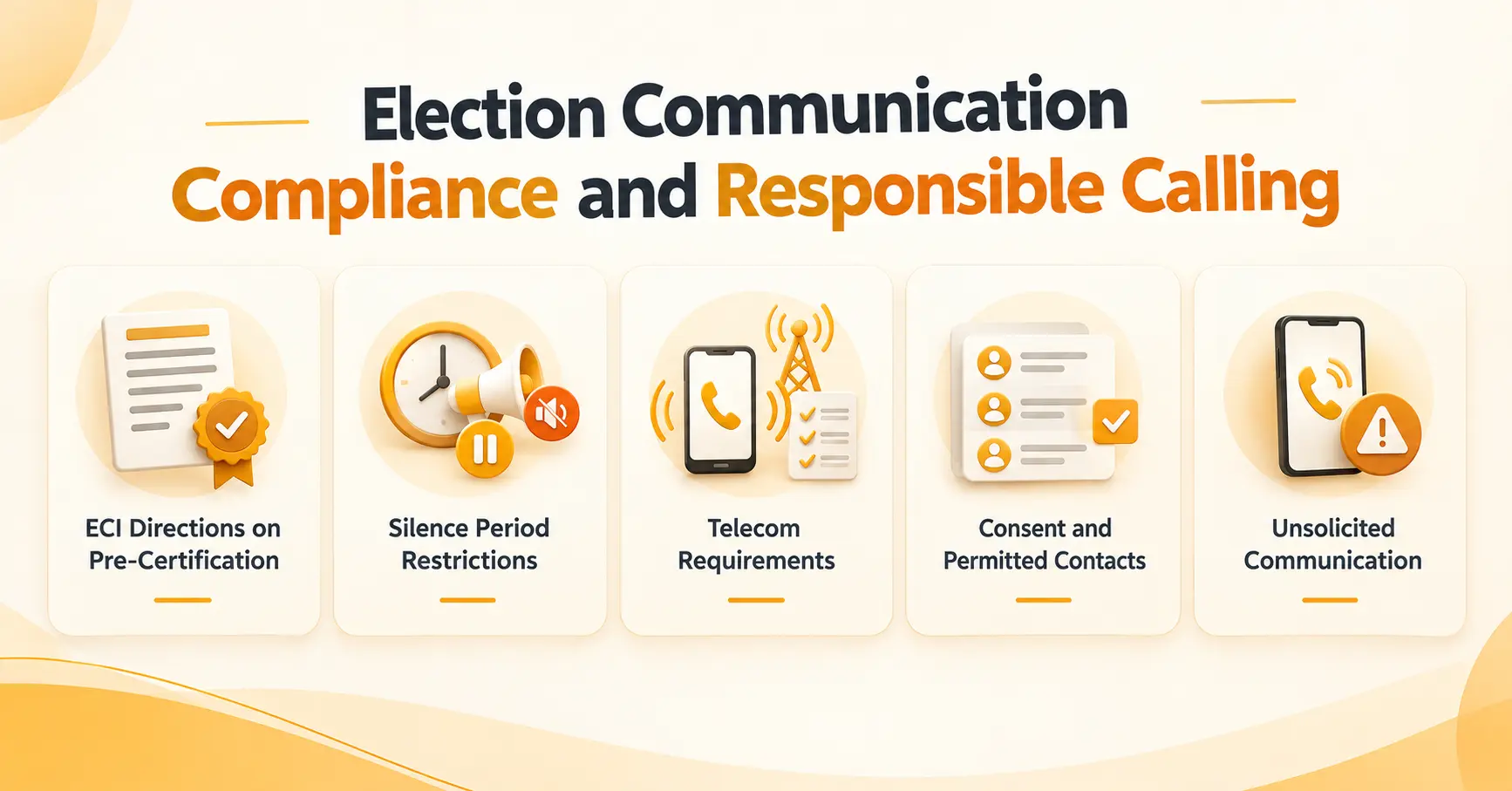
Election Communication Compliance and Responsible Calling
Election-related calling carries extra obligations. Rules change, so verify the current requirements for your state, message type, and calling method on the official ECI and TRAI websites. If you are unsure, consult a legal adviser.
Points to check include:
- ECI directions on pre-certification: In past elections, the ECI has required political advertisements, including bulk SMS and voice messages, to be pre-certified by the Media Certification and Monitoring Committee (MCMC). Confirm the process that applies to your election.
- Silence period restrictions: ECI notes from past elections have prohibited bulk SMS and voice messages in the 48 hours before polling ends. Confirm the current rule and the exact timing.
- Telecom requirements: Follow TRAI rules on commercial communication and any registration your provider requires.
- Consent and permitted contacts: Call only numbers you are permitted to call.
- Unsolicited communication: Avoid unsolicited calls, and respect requests to stop.
Never try to bypass telecom controls, consent requirements, or election advertising rules. Past instructions may not describe the current position, so check before every campaign.
Why Consider Mishtel for Bulk Voice Call Requirements?
Mishtel is an Indian business communication and cloud telephony provider. According to its service page, Mishtel’s Bulk Voice Call Service supports pre-recorded voice messages, scheduled campaigns, real-time delivery reports, retries for unanswered calls, a campaign dashboard, API integration, and custom caller ID support. It also lists multiple-language support and the option to upload your own recording or use text-to-speech.
Mishtel lists political campaigns among the sectors it serves. Read more on its political campaigns page. The page also states that DND filtering is available. Ask the team how this works for your campaign and what applies to election-related messages.
When you speak to Mishtel, have these details ready:
- The purpose of your calls
- Approximate call volume
- Language requirements
- Preferred schedule
- Reports you need
How to Plan a Bulk Voice Call Campaign
Use this checklist:
- Define the purpose. Decide what information the call must deliver.
- Prepare and verify the audio. Keep it short, clear, and accurate.
- Check the list and permissions. Confirm you may call every number.
- Confirm regulatory requirements. Check pre-certification and timing rules.
- Test the audio and call flow. Send a trial to a small internal group.
- Schedule appropriately. Avoid hours that may disturb people.
- Review reports and fix issues. Look at delivery data and adjust.
Conclusion
A bulk voice call service can help teams organise large-scale informational communication when used appropriately. It works best with clear messages, approved contact lists, thorough testing, and strict adherence to election and telecom rules. Teams in Uttar Pradesh, Punjab, Goa, and Uttarakhand should plan for language, audio quality, and call volume in their own areas.
To discuss your requirements, explore Mishtel’s Bulk Voice Call Service or contact the team.
You upload an audio message and a list of permitted contacts, then set a schedule. The system dials each number and plays the message when answered. You can then review delivery reports. Check audio quality, scheduling, reporting, capacity, language support, support availability, data security, and regulatory support. Ask for a written quotation based on your actual needs. Yes, but plan for each state’s languages, call volume, and timing. Test audio and call flow in each area first, since results can vary with local conditions. Costs usually depend on call volume, message length, features, and the provider’s plan. There is no fixed price, so request a quotation based on your requirements. Check current ECI directions, including any pre-certification and silence-period rules, and applicable TRAI requirements. Confirm consent and permitted contacts, and verify the rules for your state and message type.
How does voice broadcasting work?
What should I check before choosing a bulk voice call provider?
Can bulk voice calling support communication across multiple states?
What factors affect bulk voice calling costs?
What compliance checks are needed before election-related voice calls?