


A customer has a question about a bill. They search for your number, see an ordinary mobile number, and hesitate. Will the call cost money? Will anyone answer? Many simply give up, or send an email that takes days to answer.
A Toll-Free Number Service gives customers a clear, call-friendly way to reach your business. The business bears the applicable call charges, and the caller usually pays nothing. This guide explains how it works, who uses it, what features to look for, and how to choose a provider in India.
What Is a Toll-Free Number Service?
A toll-free number service gives a business a phone number that customers can call without paying the usual call charges. The business pays the applicable charges instead. Businesses commonly use it for customer support, helplines, and sales enquiries.
In India, toll-free numbers usually start with 1800. According to TRAI, the 1800 series is used for free phone service. The caller accesses the service free of cost, and the called party bears the expense. Exact conditions can depend on the number type and the telecom arrangements involved, so confirm the terms with your provider.
Not every number that looks “toll-free” is free for callers. The 1860 series works differently, as explained later in this article.
How Does a Toll-Free Number Work?
A toll-free number is not tied to one physical phone. It points to a telephone system you configure. The call flow is simple:
- A customer dials your toll-free number.
- The call reaches the system your provider has set up for you.
- The system applies your rules. It may play a greeting or an IVR menu or check the time of day.
- The call goes to an agent, department, or team through call routing.
- You pay the applicable call charges according to your plan.
Call routing means deciding who answers each call. You might send billing queries to one team and sales calls to another, or route calls to a different team after working hours. The routing options you get depend on the provider and your plan.
Benefits of Toll-Free Number Service for Businesses
- Better accessibility: Customers can call without worrying about call charges.
- Professional communication: A dedicated business number looks more established than a personal mobile number.
- Centralised customer contact: One number can serve all customers instead of scattered extensions or personal phones.
- Support for sales enquiries: Prospects get a simple way to reach your team.
- Customer support management: Calls can be directed to the right team with routing and IVR, where configured.
- Communication across locations: One number can serve customers in different cities and states.
These are possible benefits, not guarantees. They depend on how well your team handles calls.
Who Should Use a Toll-Free Number?
Toll-free numbers suit businesses that expect regular inbound calls. Examples:
- E-commerce: Order tracking, delivery issues, returns, and refunds.
- Banking and financial services: Account queries, card issues, and service requests.
- Healthcare: Appointment bookings and basic enquiries.
- Education: Admission questions and course information.
- Retail and FMCG: Product queries, feedback, and complaints.
- Travel and hospitality: Booking changes and itinerary questions.
- IT and service businesses: Technical support and service requests.
Not every business needs one. A small local business with few inbound calls may be fine with a regular number.
Toll-Free Number vs Regular Business Number
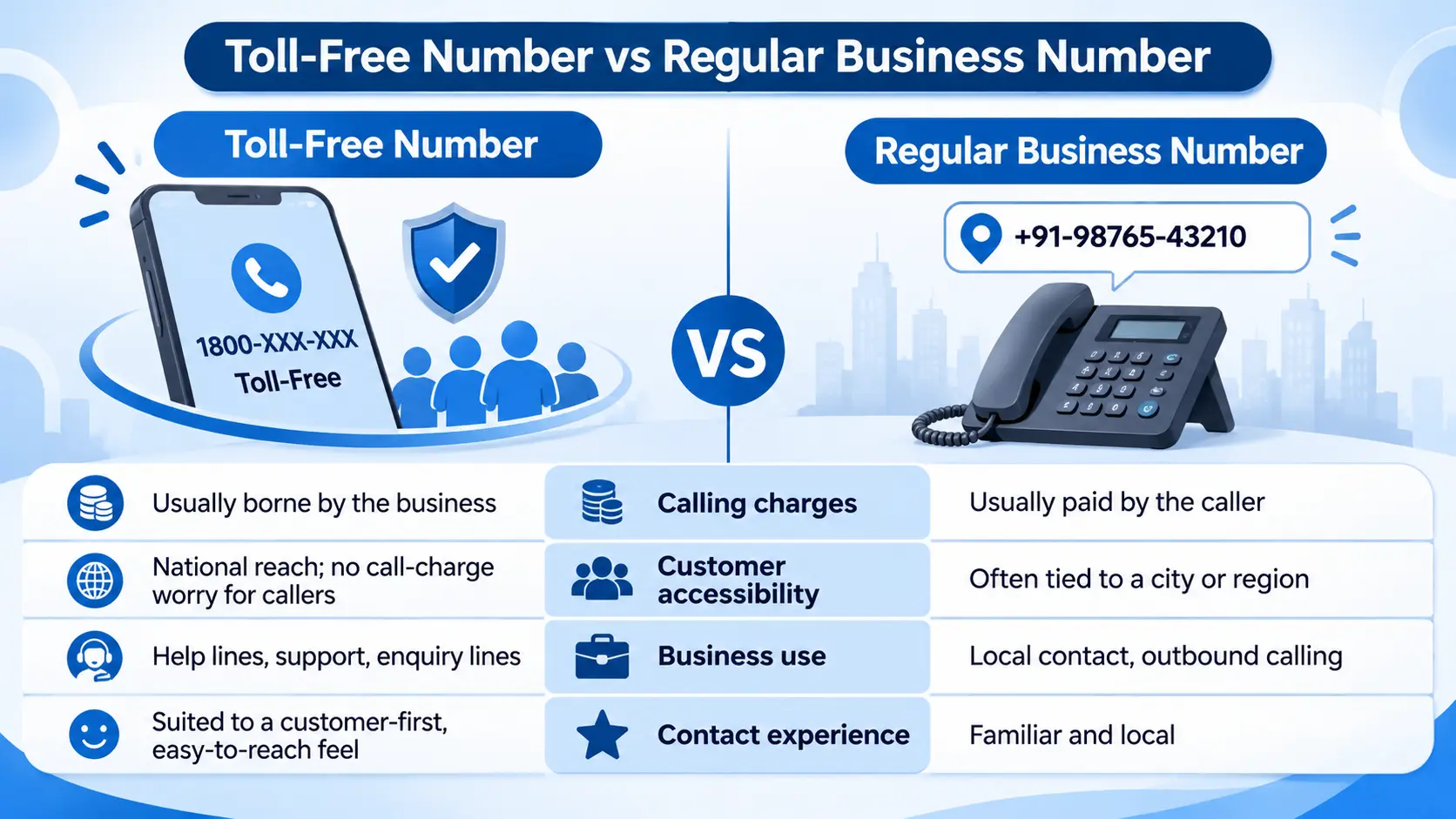
Neither is better for every business. The right choice depends on your call volume, customer base, and budget.
1800 vs 1860 Numbers: What Is the Difference?
The two series look similar, but they work differently:
- 1800: The Free Phone Service series. The caller usually pays nothing, and the business pays.
- 1860: A Universal Access Number series. It works on a shared-cost model, so the caller may pay local call charges while the business bears the remaining cost. [VERIFY BEFORE PUBLISHING: exact current charging rules for 1860 numbers.]
If your goal is to let customers call without any cost, 1800 is the relevant series. An 1860 number may suit businesses that want a national number but prefer to share the cost. Ask your provider which series is available and what the terms are.
Important Features to Consider in a Toll-Free Number Service
Look beyond the number itself. Features that help you manage customer communication include:
- Call routing: Send calls by department, agent, time of day, or location.
- IVR integration: A menu lets callers choose options such as sales, support, or billing. Mishtel’s IVR Service is one example.
- Call management: Forwarding, recording, and missed-call alerts, where available.
- Call reporting: Call logs and reports help you see busy hours and missed calls.
- Scalability: The service should handle more agents and calls as you grow.
- Technical support: You need help when something goes wrong.
Actual features depend on the provider and your configuration. Confirm each one before you commit.
Beyond the Call: Joining Up Customer Communication
A phone call is rarely the whole story. A customer may call about an order and later need a confirmation or a reminder. Businesses often pair a toll-free number with other channels:
- Bulk SMS for confirmations, alerts, and reminders after a call.
- Bulk Voice Call for recorded announcements and time-sensitive notices.
- A Cloud Call Center to manage agents and incoming calls in one place.
- An AI voice agent for routine call queries, where it suits your workflow.
Not every business needs all of these. Start with the channel that matches your main customer need.
How to Get a Toll-Free Number in India
The process is usually straightforward:
- Identify your needs. Estimate call volume, departments, and locations.
- Choose a provider. Compare features, support, and pricing.
- Confirm number availability. Ask about the 1800 and 1860 options and any preferred digits.
- Share the required business details. Providers may ask for documents or verification. [VERIFY BEFORE PUBLISHING: current KYC and documentation requirements.]
- Configure the call flow. Set up routing, IVR, or forwarding if needed.
- Test before launch. Call the number yourself to check every route.
Timelines and requirements differ by provider, so ask for details in writing.
How to Choose the Right Toll-Free Number Provider in India
Compare providers on these points:
- Pricing transparency: Understand rental, call charges, and extras.
- Number availability: Check which series and number choices are on offer.
- Service terms: Read the terms on charges, usage, and renewals.
- Call handling requirements: Make sure routing, IVR, and reporting fit your needs.
- Integration options: Ask if the service connects to your CRM or other tools.
- Customer support: Check when and how you can reach the provider.
Ask for a demo or a clear feature list, and do not rely on claims you cannot verify.
Why Consider Mishtel Services for Toll-Free Number Solutions?
Mishtel Services is an Indian business communication and cloud telephony provider. According to its Toll-Free Number Service page, the service covers 1800 and 1860 numbers. The page lists features such as multi-level IVR, smart call forwarding, time-based routing, multi-location support, call recording, missed call alerts, real-time analytics, and CRM integration.
Requirements differ for each business. The best way to see what fits is to share your call volume, departments, locations, and reporting needs with the team. You can learn more about its other services on the Mishtel website.
Conclusion
An accessible number can make it easier for customers to reach you, and a toll-free number service helps you organise those calls. The real value comes from the setup behind the number: routing, IVR, reporting, and a team ready to answer.
Looking for a toll-free number service for your business? Contact Mishtel Services to discuss your business communication needs.
An 1800 number belongs to the Free Phone Service series. Callers generally do not pay for the call, and the business bears the cost. Exact conditions depend on the number type and terms. A caller dials the number, and the call reaches the system your provider has set up. Routing rules or an IVR menu then send it to an agent or department. Yes, if they expect regular inbound calls or serve customers in several locations. A business with very few calls may find a regular number enough. With 1800 numbers, the business usually pays. With 1860 numbers, the caller may pay local charges while the business covers the rest. Confirm terms with your provider. Yes, if your plan supports it. IVR menus or routing rules can send callers to different teams or agents. Yes. An IVR menu lets callers choose options, and the system routes the call. Check the menu levels and features your provider offers. Choose a provider, confirm number availability, share the required business details, and configure your call flow. Test it before launch 1800 is the Free Phone Service series, usually free for the caller. 1860 is a shared-cost series where the caller may pay local charges. Check pricing clarity, number availability, service terms, routing and IVR options, reporting, integrations, and support. Ask for written details.
What is an 1800 number in India?
How does a toll-free number work?
Is a toll-free number useful for small businesses?
Who pays for toll-free calls?
Can a toll-free number be connected to multiple departments?
Can a toll-free number work with IVR?
How can I get a toll-free number for my business?
What is the difference between 1800 and 1860 numbers?
What should I check before choosing a toll-free number provider?