


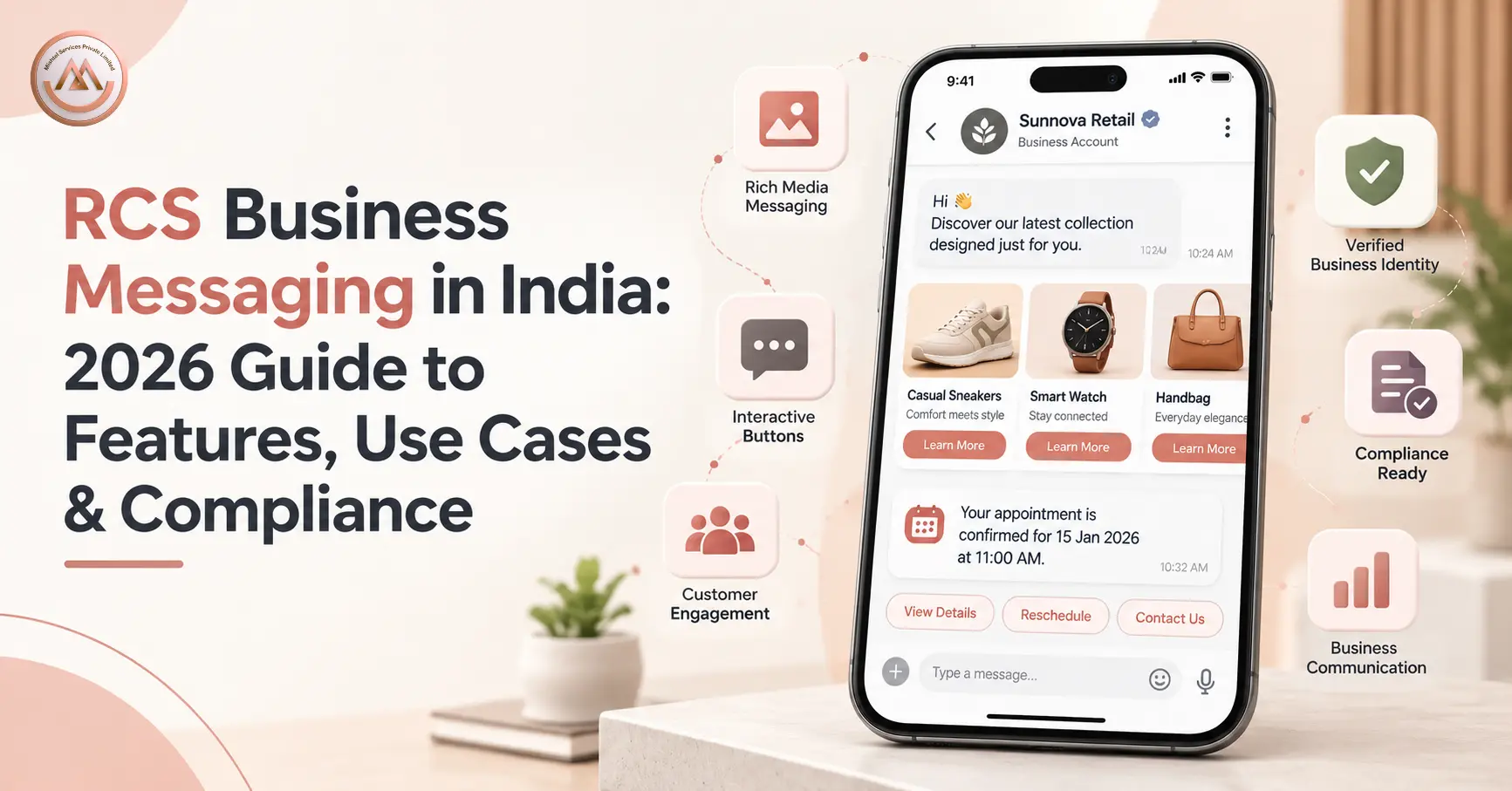
A customer places an order and gets a plain text: “Your order is shipped.” If something goes wrong, they must find a number, call, and explain everything again. Now picture the same message with the brand’s name and logo, a tracking button, and a reply option inside the same chat.
That is what RCS Business Messaging in India is designed to offer. It is still new for many Indian companies, and the rules around it are not always clear. This guide explains what RCS is, how it works, where it fits, and what to check on compliance before you launch.
What Is RCS Business Messaging?
RCS stands for Rich Communication Services. It is a messaging standard that upgrades basic SMS. Instead of plain text, a message can carry images, carousels, and buttons inside the phone’s default messaging app, with no separate app to install.
Business messaging is a different layer from the RCS chats between friends. Here, a verified business sends messages through an approved “agent” set up on Google’s RCS for Business platform. Google’s documentation describes branding, rich media, read receipts, analytics, and a “Verified” icon among its features. Which of these a customer sees depends on their device, messaging app, mobile operator, and how your provider has configured the agent.
How RCS Business Messaging Works in India
The path from setup to delivery usually has four steps:
- Agent creation. The business, or its provider, creates an RCS agent with a name, logo, and details.
- Verification and approval. The brand is verified, and operators approve the agent for launch. Timelines vary by provider and operator.
- Capability check. Before sending, the platform checks whether the recipient’s phone and network can receive RCS.
- Delivery and interaction. Compatible customers see the rich message and can tap buttons or reply. Others may need a fallback, such as SMS.
Reports indicate that Jio, Airtel, and Vi now support RCS business messaging. In September 2026, Jio reportedly extended commercial RCS business messaging to iPhone users, along with a revised pricing framework. Coverage, features, and pricing can differ by operator and change over time. Check the current position with your provider and Google’s carrier documentation.
Key RCS Business Messaging Features
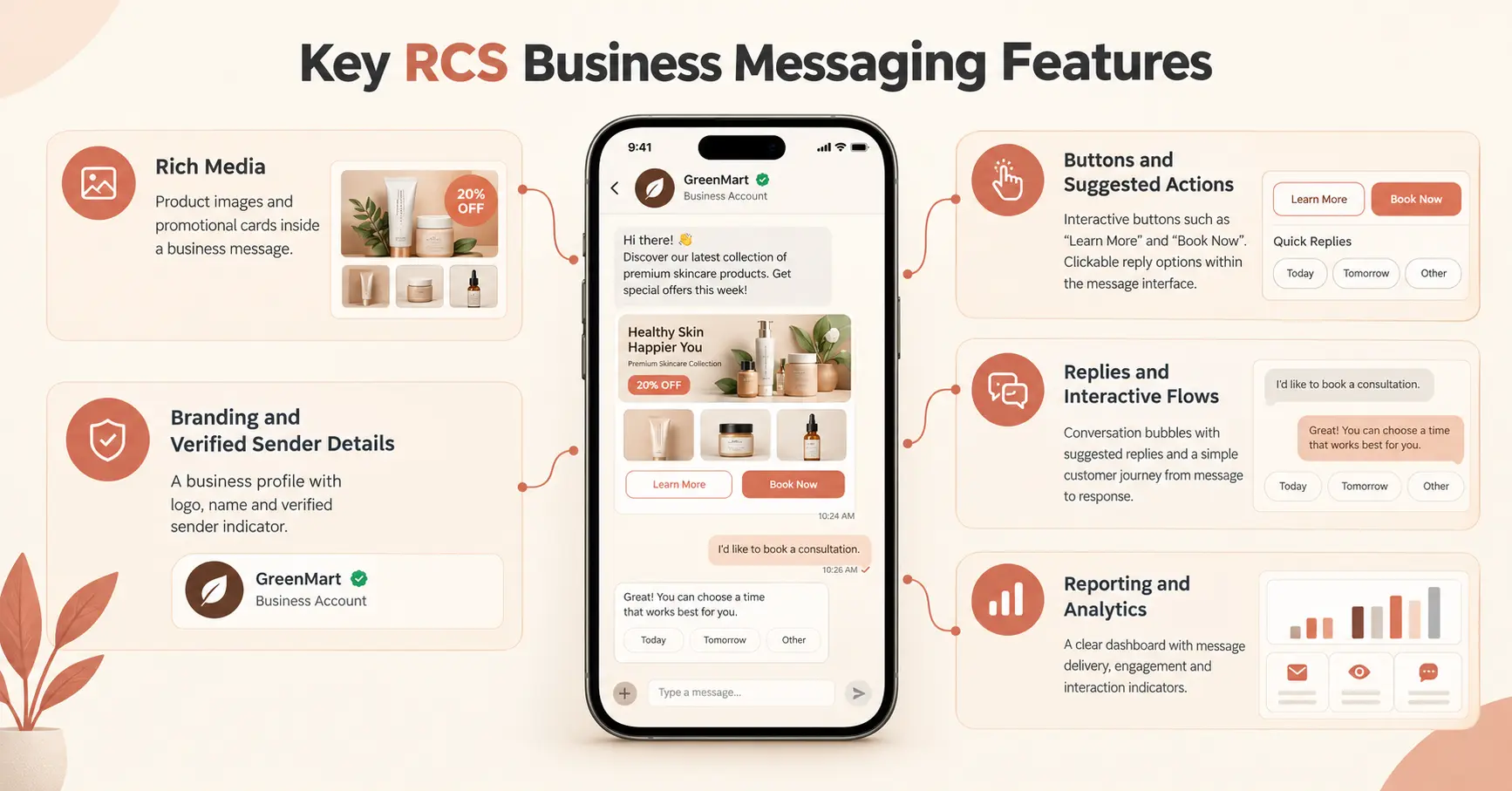
No feature is guaranteed on every device, operator, or provider. Treat each as “available where supported.”
Practical RCS Business Messaging Use Cases in India
| Industry | Communication need | Example | Limitation to keep in mind |
| E-commerce and retail | Order and delivery updates | Shipping alert with a “Track order” button | Customers on non-RCS devices need a fallback |
| Banking and financial services | Service notifications | Notice about a statement or service request | Follow sector rules and avoid sensitive data in messages. |
| Healthcare | Appointment reminders | Reminder with “Confirm” and “Reschedule” buttons | Protect patient privacy and limit details shown. |
| Travel and hospitality | Booking updates | Check-in details with a map link. | Time-sensitive messages need a reliable fallback. |
| Customer support | Guided help | Options such as “Track order” or “Talk to support” | Complex issues still need a human agent. |
Promotional messaging is not suitable for every use case. A reminder or service update usually reads very differently from an offer, and customers may expect different things from each.
RCS vs SMS for Businesses
| Area | SMS | RCS |
| Message format | Plain text (with links) | Text, images, carousels, and buttons |
| Interactivity | Very limited | Buttons and replies, where supported |
| Device and network compatibility | Works on almost any phone | Needs a compatible device, app, and operator |
| Customer experience | Simple and familiar | Richer, closer to an app-like chat |
| Delivery considerations | Mature, well-understood routes | Capability varies, so a fallback is often needed. |
| Typical use | OTPs, alerts, short notices | Guided updates, bookings, support flows |
SMS offers broader reach, while RCS can support richer interactions on compatible devices. Neither is better in every situation. Many businesses use both.
RCS Business Messaging Compliance in India
This section separates three things that are often mixed together: legal rules, platform policies, and good practice. It is general information, not legal advice.
Legal and regulatory.
- TRAI’s Telecom Commercial Communications Customer Preference Regulations, 2018 (TCCCPR) set rules for commercial communication by SMS and voice calls. They cover sender registration, headers, content templates, and consent through the DLT platform. A 2025 amendment added rules on handling messages that contain URLs, APKs, and OTT links. See the TCCCPR text and the February 2025 amendment.
- Whether and how these rules apply to RCS is described differently by different vendors. I could not find an authoritative TRAI statement that settles it, so do not assume either way. Ask your provider and operator in writing which registrations and templates your RCS use case needs.
- Personal data you collect and use is covered by the Digital Personal Data Protection Act, 2023. Regulated sectors such as banking and healthcare may also have their own rules.
Platform policies. Google requires brand verification and has terms and policies for RCS for Business. Operators also approve agents. Read Google’s terms and policies before launch.
Good practice.
- Message only people who have agreed to hear from you, and make the purpose clear.
- Give customers an easy way to opt out, and honour it.
- Keep sensitive details out of messages, especially in finance and healthcare.
- Keep records of consent.
Rules change, so confirm the current position for your channel and use case before each campaign. A checklist does not guarantee compliance.
What Should Businesses Check Before Adopting RCS?
- Audience and devices: What share of your customers can receive RCS?
- Verification and onboarding: What documents and approvals are needed, and how long might they take?
- Message type: Is it a service update, a reminder, or a promotion?
- Consent and preferences: Can you show how each contact opted in?
- Content and language: Do you have clear creative assets in the languages your customers use?
- Platform support and reporting: What reports and support does the provider offer?
- Budget: Ask for pricing in writing. Costs can differ by operator and message type.
- Fallback channel: Decide what happens when RCS is unavailable, such as SMS.
How Mishtel Can Help Businesses Explore Messaging Solutions
Mishtel is an Indian business communication and cloud telephony provider. Its RCS Business Messaging page describes rich messages with images, videos, and carousels, call-to-action buttons, a verified brand profile, and two-way conversations. It also lists campaign setup support, Google template approval, API integration, and ongoing technical support.
For short alerts and wider reach, Mishtel also offers Bulk SMS, which can sit alongside RCS as a complementary channel. The right mix depends on your audience, message type, and compliance setup.
If you want to explore these options, share your use case, customer base, and expected volume with the Mishtel team. They can explain what is available and what you need to prepare.
Conclusion
RCS Business Messaging in India can make customer communication clearer and more interactive, but only where devices, networks, and approvals line up. Before you start, know your audience’s devices, choose suitable use cases, confirm your consent practices, and check how the rules apply to your channel.
A careful rollout, with a fallback channel, is more practical than a rushed one. To explore options, you can look at Mishtel’s verified communication services or contact the team to discuss your requirements.
SMS is plain text and widely compatible. RCS can add images, buttons, and replies, but only on compatible devices and networks. No. It depends on the phone, messaging app, and operator. That is why many businesses keep a fallback such as SMS. Yes, Google’s platform uses brand verification, and operators approve agents before launch. Ask your provider about the steps and timeline. Yes, where supported. Rich media and suggested actions are core features, but how they display varies by device and app. Check TRAI rules, data protection law, sector rules, and Google and operator policies. Confirm in writing how DLT and template rules apply to your RCS use case. Yes, if your provider supports fallback. Confirm how it works, what it costs, and whether your SMS templates are registered. Ask about operator coverage, verification support, reporting, fallback options, compliance guidance, and written pricing. Request a demo with your real use case.
How is RCS Business Messaging different from SMS?
Does RCS Business Messaging work on every smartphone?
Do businesses need verification to use RCS Business Messaging?
Can RCS Business Messaging include images and interactive buttons?
What compliance considerations should Indian businesses know?
Can businesses use SMS as an alternative when RCS is unavailable?
How can a business evaluate an RCS messaging provider?