

Ever called a company helpline in India? You have probably dialed a number starting with 1800 or 1860.
Both are Toll-Free Numbers. But they work very differently. Choose the wrong type, and you may pay more than expected or your customers may get charged without knowing.
This guide explains both types, when to use each one, and how to pick the right option for your business.
What Is a Toll-Free Number?
A toll-free number is a special phone number that lets customers call your business for free. You pay the charges. The caller pays nothing.
In India, two types are common: 1800 and 1860. Both look similar, but the billing is completely different.
1800 Numbers: Completely Free for the Caller
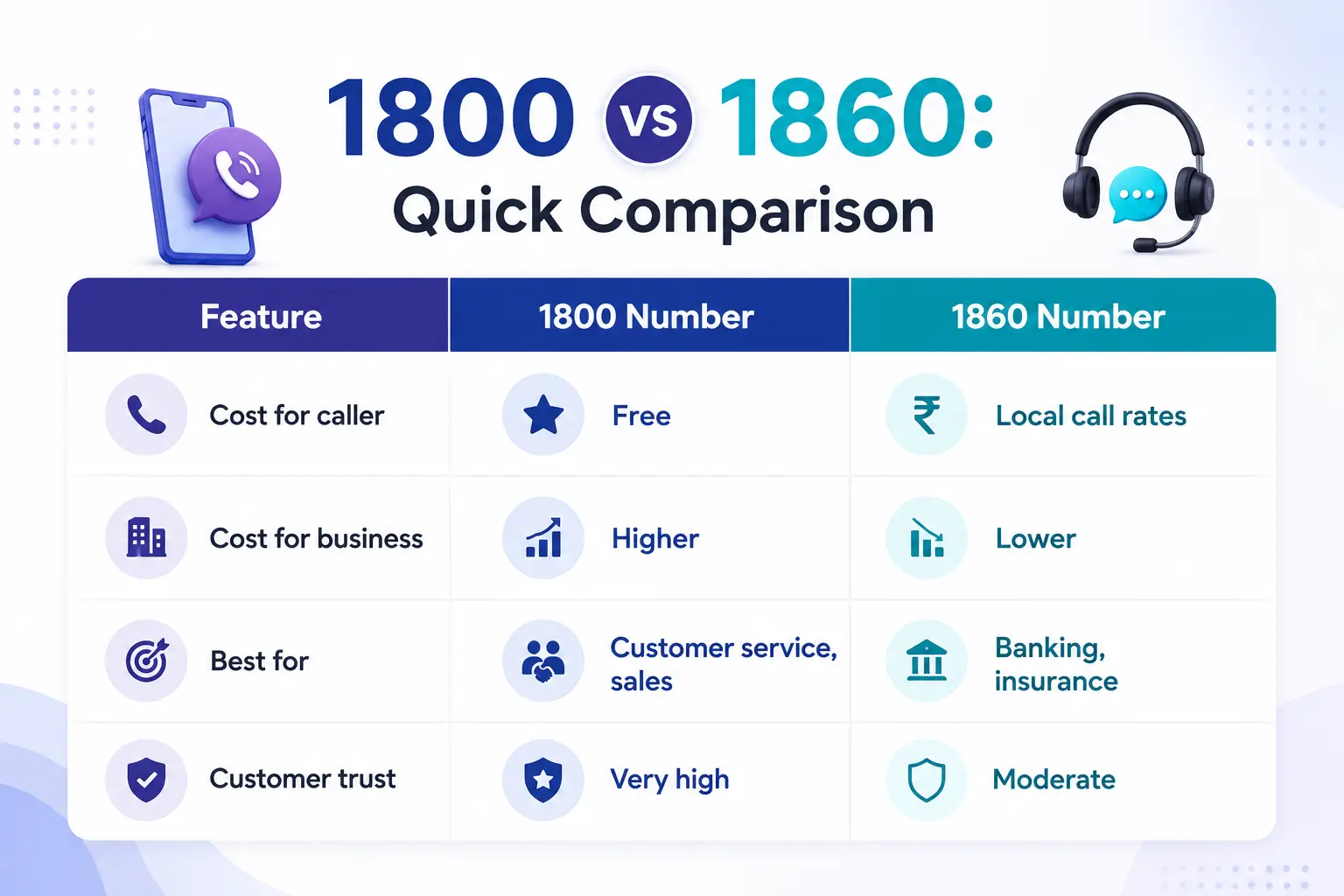
A 1800 toll-free number is the true free option. When a customer dials it, they pay nothing. You absorb the full cost.
This makes 1800 numbers ideal for customer support lines, inbound sales teams, and any business that wants to remove every barrier to customer contact.
Key features:
- Zero cost for the caller from any network or device
- Works from mobile phones, landlines, and payphones
- Ideal for high-volume inbound campaigns
- Builds strong brand trust and credibility
For businesses that want to handle calls smartly, pairing an 1800 number with an IVR Service routes every caller to the right department automatically, with no manual effort needed.
1860 Numbers: Caller Pays Local Rates
An 1860 number looks like a toll-free number, but the caller pays local call rates. The business also pays a smaller per-minute charge. This is a shared-cost model.
1860 numbers were popular when call rates were high. Today, with most mobile plans offering cheap or free calls, they are less common. But they are still used in banking, insurance, and government services.
Key features:
- Caller pays local call rates, not free
- Business pays a reduced per-minute rate
- Lower cost for the business vs 1800
- Less effective at removing call hesitation
If your goal is to increase inbound calls and improve customer access, 1800 is almost always the better choice.
1800 vs 1860: Quick Comparison
Who Should Use Each Type?
1800 numbers work best for:
- E-commerce brands handling returns and complaints
- Clinics and hospitals offering patient support
- Educational institutes managing admissions
- Real estate companies capturing property inquiries
1860 numbers work best for:
- Banks and NBFCs with existing customers
- Insurance companies with policyholders
- Government and utility service providers
For most businesses trying to grow inbound calls, 1800 is the right choice.
Features to Look for in a Toll-Free Number Provider
The features behind your number matter as much as the number itself.
Smart call routing — Calls must reach the right team fast. A Cloud Call Center connected to your toll-free number tracks every call, manages agents, and reports performance in real time.
Chat alternative — Some customers prefer messaging over calls. A WhatsApp Business API integration lets customers contact you via chat from the same platform.
Missed call capture — Some customers call and hang up before connecting. A Missed Call Service captures these and triggers automatic follow-ups so no lead is lost.
Outbound campaigns — A toll-free number handles inbound calls. For outbound, a Bulk Voice Call Service reaches thousands of customers with automated messages from the same platform.
Website calls — Let website visitors call you instantly using a Click2Call Service button. One click and they connect no dialing needed.
Toll-Free Number Pricing in India
Pricing typically includes three components:
Monthly rental — A fixed charge for the number. Usually ₹500 to ₹2,000 per month depending on the provider.
Per-minute charges — You pay for incoming call time. Rates depend on call volume and plan terms.
Add-on features — IVR, call recording, and analytics may be bundled or charged separately.
For campaigns that also require text outreach, a Bulk SMS Service paired with your toll-free number creates a complete inbound-outbound communication setup.
Always ask providers about hidden fees and minimum commitments before signing up.
Why Choose Mishtel for Your Toll-Free Number?
Mishtel provides both 1800 and 1860 toll-free numbers as part of a complete cloud communication platform. Here is why businesses across India choose Mishtel:
Instant activation. Your number goes live within hours. No paperwork. No delays.
Smart IVR included. Calls route intelligently from the first ring. Callers always reach the right person.
Live call dashboard. Monitor volumes, agent performance, and missed calls in real time.
Full communication stack. Voice, SMS, WhatsApp, email, and RCS all connected in one place. Your toll-free number does not work alone; it works with everything.
Regional language support. Serve callers in Hindi, Tamil, Telugu, Marathi, and more.
99.9% uptime. Your line stays active even during peak campaign periods.
Transparent pricing. No hidden charges. Plans for every business size.
Final Thoughts
The difference between 1800 and 1860 comes down to one question: who should pay for the call?
For maximum inbound volume and customer trust, 1800 wins. For cost-sharing in established customer relationships, 1860 has its place.
Either way, the platform behind your 1800 or 1860 number determines how well you convert every call into a customer.