

Businesses handle hundreds or thousands of customer calls every day. These calls may include sales enquiries, customer support, lead follow-ups, appointment reminders, and payment reminders.
Traditional IVR systems have been helping businesses manage these calls for years. However, AI Voice Agents are changing how businesses handle phone conversations.
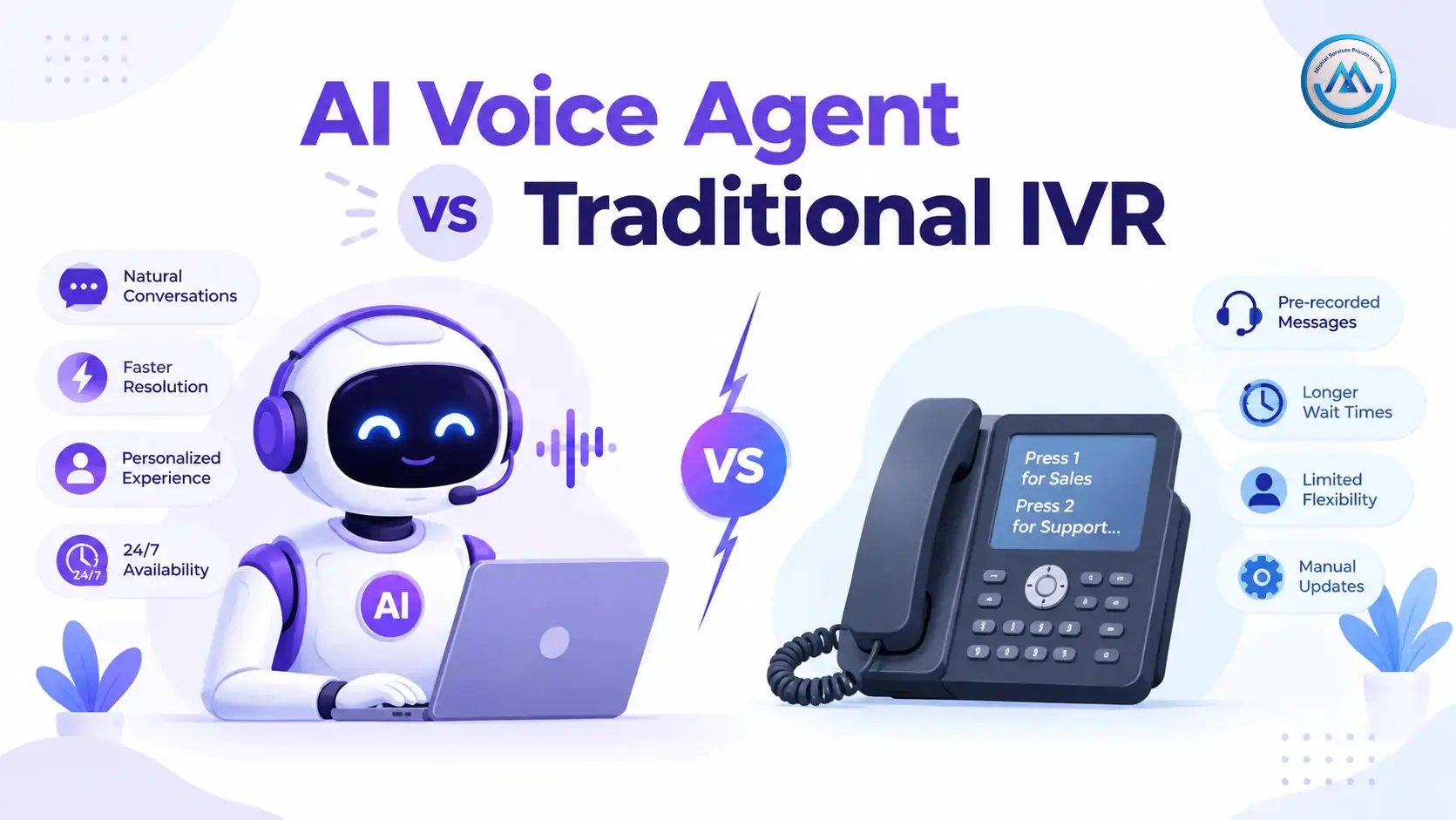
So, what is the difference between an AI Voice Agent and IVR? Which one is better for your business?
The answer depends on your business needs, call volume, and customer communication goals.
In this guide, we will compare AI Voice Agents and traditional IVR, explain their key differences, and help you choose the right solution.
Businesses can also combine AI calling with other communication solutions from Mishtel to create a complete customer communication system.
What Is an AI Voice Agent?
An AI Voice Agent is an AI-powered system that can make and receive business calls. It can understand customer questions, respond to requests, collect information, qualify leads, and transfer calls to human agents when required.
Unlike a basic phone menu, an AI Voice Agent can handle more natural conversations.
For example, a customer may say:
“I want to know the price of your service.”
The AI can understand the request and provide a relevant response. It can also ask follow-up questions based on the conversation.
Businesses can use AI Voice Agents for:
- Lead qualification
- Sales follow-ups
- Customer support
- Appointment reminders
- Payment reminders
- Customer surveys
- Feedback calls
- Outbound calling
To understand the technology in more detail, read our guide on What Is an AI Voice Agent?.
What Is Traditional IVR?
IVR stands for Interactive Voice Response.
It is an automated phone system that allows customers to interact using keypad inputs or voice commands.
You may have heard an IVR message like:
“Press 1 for Sales.”
“Press 2 for Customer Support.”
“Press 3 for Billing.”
The customer selects an option, and the system routes the call to the right department.
Businesses use IVR Service for call routing, basic self-service, customer queues, and call transfers.
Traditional IVR is still useful for many business communication needs.
However, it can be limiting when customers need to have a detailed or flexible conversation.
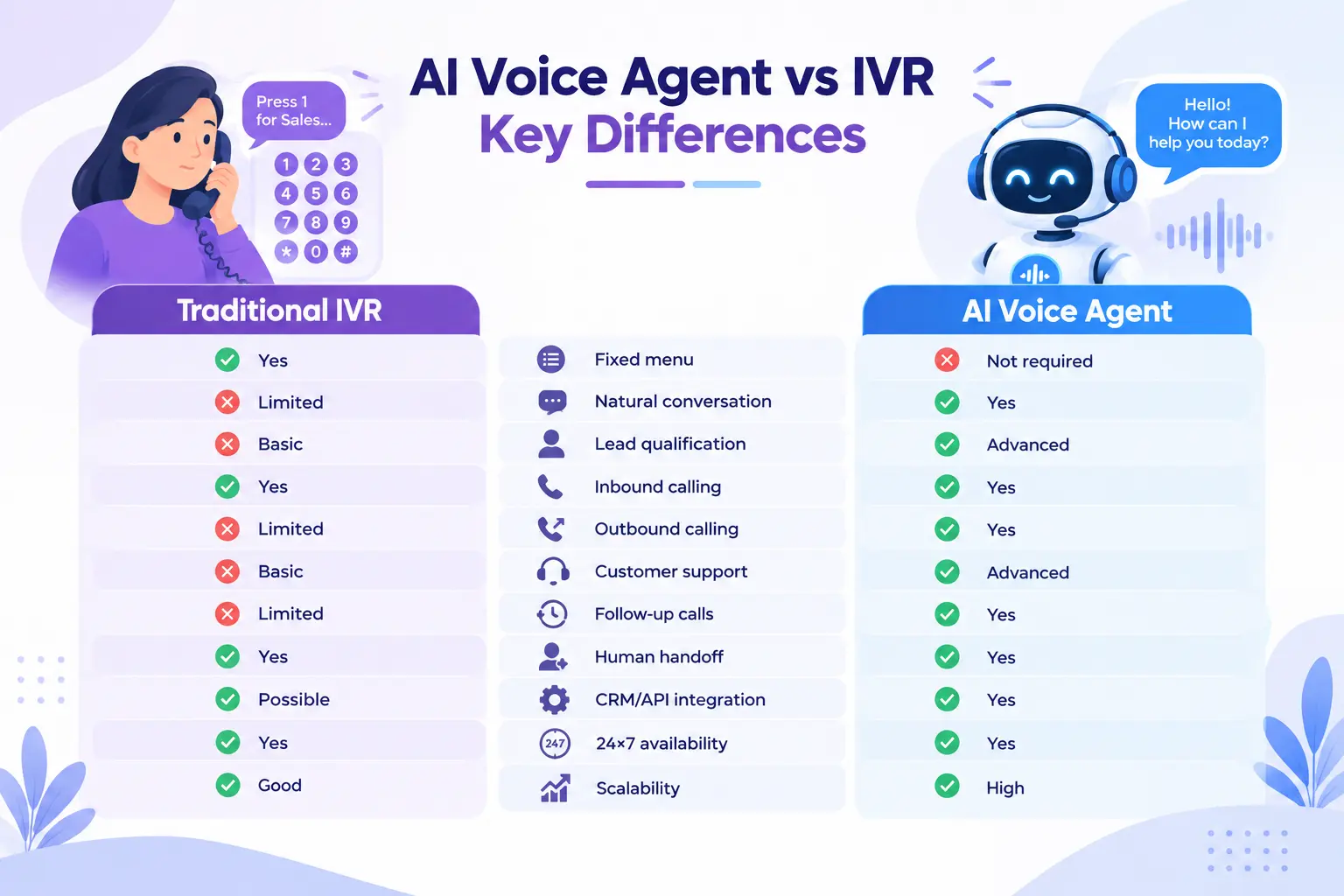
AI Voice Agent vs IVR: Key Differences
The biggest difference is how both systems handle customer conversations.
Traditional IVR usually follows predefined menus and workflows.
An AI Voice Agent can understand natural language and respond based on customer intent.
1. Conversation Experience
Traditional IVR works through predefined options.
Customers usually need to select the option that matches their requirement.
An AI Voice Agent can understand what the customer says in their own words.
For example, instead of asking a customer to press a number, the AI can ask:
“How can I help you today?”
The customer can explain the problem naturally.
This makes AI Voice Agents more suitable for businesses that want conversational customer interactions.
2. Lead Qualification
Lead qualification is another important difference.
An IVR can collect basic information, but it is not designed for detailed sales conversations.
An AI Voice Agent can ask questions and understand customer responses.
For example:
AI: Are you looking for a business calling solution?
Customer: Yes.
AI: What type of calling do you need?
Customer: I need automated follow-ups for leads.
The AI can continue the conversation and collect relevant information.
This can help sales teams focus on leads that show genuine interest.
For high-volume campaigns, businesses can also use a Bulk Voice Call Service to reach a large number of customers through automated voice calls.
3. Customer Support
IVR can route customers to the correct support team.
For example:
Press 1 for Sales.
Press 2 for Technical Support.
However, customers may still need to explain their issue to a human agent.
An AI Voice Agent can handle common questions and understand customer intent before transferring the call.
If the issue is complex, the AI can hand the conversation over to a human agent.
Businesses that need dedicated human support can combine AI automation with a Cloud Call Center solution.
This creates a flexible combination of AI and human support.
4. Outbound Calling
Businesses often need to make large numbers of outbound calls.
These calls may include:
- Lead follow-ups
- Appointment reminders
- Payment reminders
- Renewal reminders
- Customer surveys
- Feedback calls
AI Voice Agents can automate many of these repetitive conversations.
This can reduce the amount of manual calling required by sales and support teams.
Businesses can also combine automated calling with a Click2Call Service to make it easier for customers to connect with sales or support teams.
Can AI Voice Agents Replace IVR?
Not always.
IVR and AI Voice Agents solve different communication problems.
IVR is useful when a business needs simple call routing and structured customer journeys.
AI Voice Agents are useful when a business needs conversational automation.
Businesses can also use both technologies together.
For example:
Customer → IVR → AI Voice Agent → Human Agent
The IVR can manage initial routing.
The AI Voice Agent can handle the conversation.
A human agent can take over when personal assistance is needed.
This hybrid approach can create a more flexible customer communication system.
Benefits of Using an AI Voice Agent
AI Voice Agents can help businesses automate repetitive phone conversations.
24×7 Call Handling
AI Voice Agents can handle calls outside normal business hours.
This can help businesses respond to customers even when human teams are unavailable.
Faster Lead Follow-Ups
Sales teams can lose leads when follow-ups take too long.
An AI Voice Agent can automate initial follow-up calls and identify interested prospects.
High-Volume Calling
Businesses can automate repetitive calls at scale.
This is useful for companies that handle a large number of leads or customers.
Consistent Communication
AI can follow predefined business workflows.
This helps maintain consistency across repetitive customer interactions.
Human Agent Handoff
AI does not need to handle every conversation.
When human assistance is required, the call can be transferred to an agent.
CRM and API Integration
Businesses can connect AI calling workflows with CRM systems and APIs.
This can help automate lead updates, customer information collection, and follow-up workflows.
AI Voice Agent Use Cases
AI Voice Agents can be used across many industries and business processes.
Sales and Lead Generation
Businesses can automate initial calls, qualify leads, and schedule follow-ups.
Customer Support
AI can answer common questions and transfer complex issues to human agents.
Appointment Reminders
Healthcare, education, consulting, and service businesses can automate appointment reminders.
Payment and Renewal Reminders
Businesses can use automated voice calls to remind customers about payments, renewals, or subscriptions.
Customer Feedback
AI Voice Agents can conduct surveys and collect customer feedback through phone conversations.
Real Estate
Real estate businesses can use AI calling to follow up with property leads and understand customer requirements.
Businesses can also use a Missed Call Service to capture customer interest and generate callbacks.
AI Voice Agent for Business Calling
Modern businesses need more than basic call routing.
They need faster responses, better lead follow-ups, and scalable customer communication.
Mishtel’s AI Voice Agent for business calling can help businesses automate inbound and outbound calling workflows.
Businesses can use AI-powered calling for lead qualification, customer support, follow-ups, reminders, and other repetitive phone-based processes.
AI calling can also work alongside other business communication solutions. For inbound customer communication, businesses can combine AI calling with a Toll-Free Number Service to make it easier for customers to reach their business.
AI Voice Agent vs IVR: Which One Should You Choose?
Choose traditional IVR if your business mainly needs:
- Fixed call menus
- Department routing
- Basic self-service
- Simple customer journeys
Choose an AI Voice Agent if your business needs:
- Natural conversations
- Lead qualification
- Automated follow-ups
- Outbound calling
- Conversational customer support
- Scalable calling automation
- CRM or API-based workflows
If your business needs both structured routing and conversational automation, you can combine IVR with an AI Voice Agent.
Final Verdict
So, AI Voice Agent vs IVR — which is better?
There is no single answer for every business.
Traditional IVR is a strong option for simple call routing and structured customer journeys.