



Political campaigns involve more than public meetings and traditional outreach. In addition, campaign teams need clear ways to share information, manage calls, send updates, and coordinate communication across different teams.
As campaign operations grow, handling every communication task manually can become difficult. Digital communication services can help organize these activities through SMS, voice calls, IVR, cloud calling, and other technologies.
This guide explains how digital communication can support political campaign operations and how different communication channels can be used for different requirements.
What Is Political Campaign Communication?
Political campaign communication refers to the different ways a campaign organization shares official information with its audience, teams, and contacts.
Depending on the campaign requirements, communication may include:
- SMS updates
- Voice calls
- Automated calling
- IVR-based call handling
- Website calling
- Missed call campaigns
- Cloud-based call management
- AI-powered voice conversations
Each channel has a different purpose. A campaign team can select the services that match its communication volume, team structure, and operational requirements.
Why Is Digital Communication Important for Political Campaigns?
Campaign teams often manage communication across multiple locations and departments. They may also need to handle a large number of calls or messages within a planned time.
A digital communication system can help make these activities more structured.
Some common benefits include:
Faster Information Sharing
SMS and voice communication can help campaign teams share approved information with a large contact base.
Better Call Management
Cloud-based calling and IVR can help organize incoming and outgoing calls.
Less Repetitive Work
Automated communication can reduce repetitive manual tasks, allowing team members to focus on activities that require direct human involvement.
Centralized Communication
Different communication channels can be managed as part of a connected communication setup.
Scalable Operations
Cloud communication tools can support changing communication requirements as campaign activities increase.
Bulk SMS for Political Campaign Communication
SMS remains a simple way to deliver short and important information.
With a Bulk SMS Service, campaign teams can send approved updates, event information, reminders, and other informational messages to large contact lists.
SMS can be useful when the message needs to be short and easy to read.
For example, campaign teams may use SMS for:
- Event reminders
- Meeting information
- Schedule updates
- Office information
- General announcements
SMS can also be combined with other communication channels to create a broader communication workflow.
Voice Calls for Large-Scale Communication
Some information may be easier to communicate through voice.
A Bulk Voice Call Service can deliver pre-recorded voice messages through an automated calling system.
This can reduce the need for campaign staff to make the same call repeatedly.
Voice communication may be used for:
- Event announcements
- Meeting reminders
- General information
- Scheduled notifications
- Recorded messages
The voice message can be prepared in the required language before the calling activity begins.
IVR for Automated Call Handling
Campaign offices may receive many calls during important campaign periods.
An IVR Service can provide callers with predefined options and help route calls according to their selection.
For example:
- Press 1 to hear general information.
- Press 2 to get event details.
- Press 3 to connect with the relevant team.
This type of setup can help manage basic enquiries without requiring a team member to answer every call manually.
IVR is particularly useful when the communication flow is structured, and the caller needs to select from predefined options.
AI Voice Agent for Campaign Communication
Some conversations cannot be handled effectively through fixed IVR menus.
An AI Voice Agent can be configured to handle defined phone conversations using natural language.
Depending on the setup, it can:
- Answer routine questions
- Collect required information
- Follow a defined conversation flow
- Handle basic enquiries
- Transfer calls to a human team member
This makes AI Voice Agents different from traditional IVR systems.
IVR generally follows predefined menus, while an AI Voice Agent can be configured for more conversational interactions.
Campaign organizations should define the permitted use case, information, and communication workflow before deploying an AI-powered calling system.
Cloud Call Center for Campaign Teams
Political campaigns may have multiple team members handling calls from different locations.
A Cloud Call Center can bring these calling activities into one cloud-based environment.
Teams can use a cloud calling setup for:
- Incoming calls
- Outgoing calls
- Call routing
- Agent management
- Call records
- Communication monitoring
A cloud-based system can also make coordination easier when several team members need access to the same calling infrastructure.
Missed Call as a Simple Response Channel
Not every communication activity requires a full conversation.
A Missed Call Service can provide a simple way for a person to respond by giving a missed call to a designated number.
The system can then trigger a predefined response or workflow.
This type of communication can be useful when the first interaction needs to remain simple and quick.
Click2Call for Campaign Websites
Campaign websites can also become a direct communication point.
With Click2Call Service, website visitors can start a phone call through a configured calling system.
Instead of manually entering a phone number, the visitor can use the available call option on the website.
This can create a simple connection between a digital campaign page and the communication team.
Toll-Free Number for Campaign Communication
A dedicated number can make it easier for people to contact a campaign office.
A Toll-Free Number can be included as part of a broader communication setup, depending on the organization’s requirements and applicable telecom conditions.
It can work alongside IVR and cloud calling to provide a structured inbound communication channel.
How to Build a Multi-Channel Campaign Communication System
A campaign does not need to use every available communication service.
The right setup depends on the actual communication requirements.
| Requirement | Suitable Communication Channel |
| Short updates | Bulk SMS |
| Recorded information | Voice Calls |
| Fixed call options | IVR |
| Conversational calls | AI Voice Agent |
| Team-based calling | Cloud Call Center |
| Simple response | Missed Call |
| Website calling | Click2Call |
| Dedicated inbound number | Toll-Free Number |
Using different channels for different tasks can help campaign teams keep communication more organized.
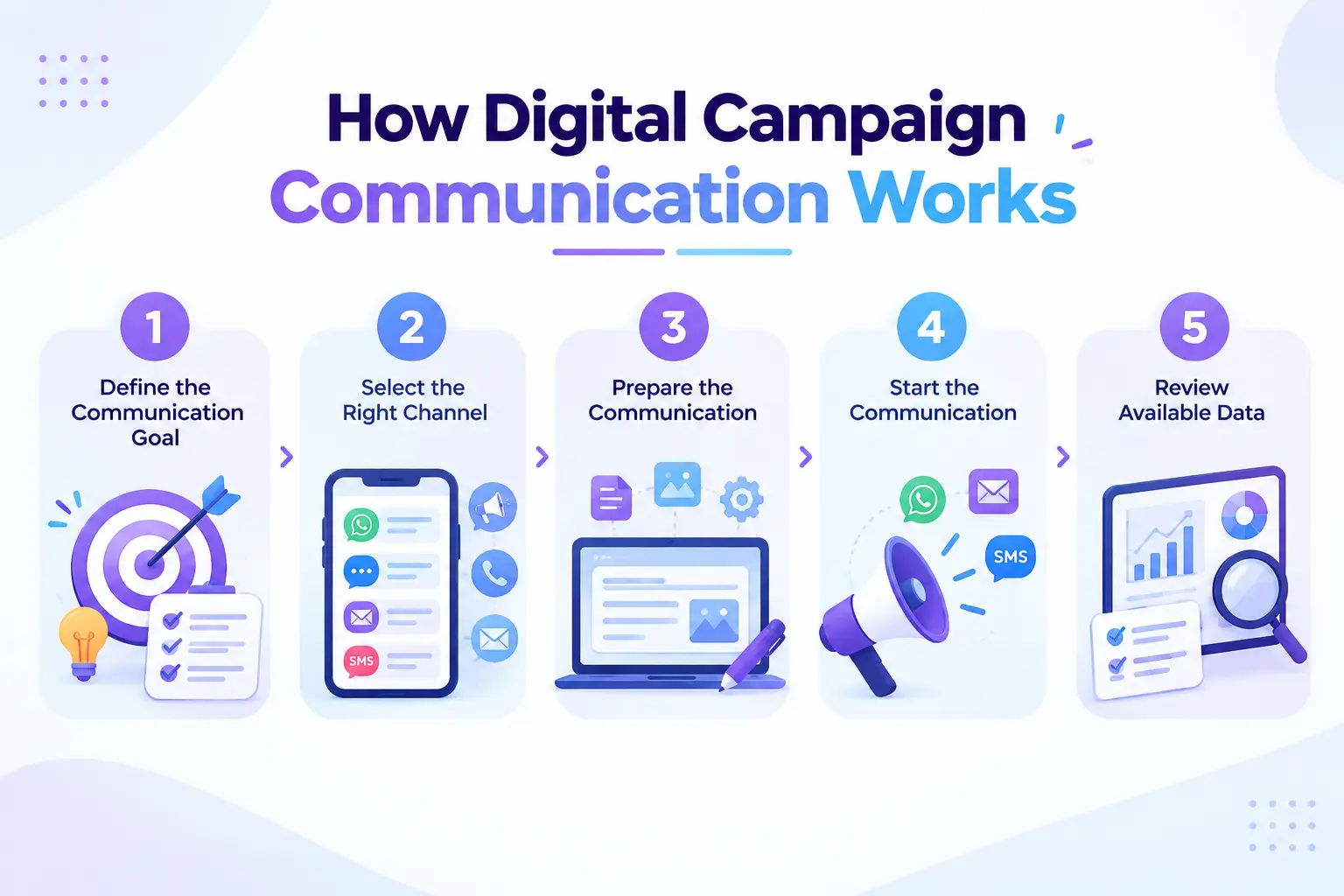
How Digital Campaign Communication Works
A basic communication workflow can be divided into five steps.
Step 1: Define the Communication Goal
First, identify what information needs to be communicated and who needs to receive it.
Step 2: Select the Right Channel
Choose SMS, voice calls, IVR, AI Voice Agent, cloud calling, or another suitable communication method.
Step 3: Prepare the Communication
Create the SMS content, voice recording, IVR flow, or call script.
Step 4: Start the Communication
Launch the selected communication activity according to the planned schedule and applicable requirements.
Step 5: Review Available Data
Where reporting is available, campaign teams can review delivery information, call activity, and other communication data.
This process can help keep communication activities structured and easier to manage.
Combining Multiple Communication Services
Different communication channels can work together.
For example, a campaign team may use SMS to share basic information, voice calls for recorded announcements, IVR for inbound call handling, and a Cloud Call Center for conversations that require human assistance.
An AI Voice Agent can also be included when a campaign requires defined conversational call handling.
The purpose of combining channels is not to use more technology. It is to use the appropriate channel for each communication requirement.
Compliance in Political Campaign Communication
Political and election-related communication in India may be subject to election laws, Election Commission directions, telecom requirements, and platform policies.
Campaign organizations should review the rules applicable to their specific activity before starting communication campaigns.
For SMS communication, applicable DLT and telecom requirements should also be followed.
Campaign organizations are responsible for their communication content, contact data, permissions, approvals, and compliance with applicable requirements.
Who Can Use Digital Campaign Communication Services?
Digital communication solutions may be useful for different types of campaign organizations, including:
- Political parties
- Candidates and authorized campaign offices
- Political organizations
- Campaign management teams
- Communication agencies
- Constituency-level teams
- Regional campaign teams
The services required can vary depending on campaign size, communication volume, team structure, and operational needs.
Conclusion
Digital communication can help campaign teams organize large-scale communication activities through different channels.
SMS can be used for short updates, voice calls for recorded information, IVR for structured call handling, AI Voice Agents for defined conversations, and Cloud Call Centers for team-based calling.
A Bulk SMS Service can be used to send short, approved informational messages to large contact lists. Yes. Pre-recorded voice messages can be delivered through an automated Bulk Voice Call Service, subject to applicable requirements. IVR can provide predefined call menus, automated information, and call-routing options. An AI Voice Agent can be configured for defined conversations, routine questions, information collection, and human handoff where required. Yes. Campaign teams can combine SMS, voice calls, IVR, AI Voice Agent, cloud calling, and other channels according to their communication workflow. Political and election-related communication may be subject to election, telecom, and platform requirements. Organizations should verify the rules applicable to their specific activity.
Which service is useful for sending bulk campaign messages?
Can voice calls be automated for campaign communication?
What is the role of IVR in campaign communication?
Can an AI Voice Agent handle campaign-related calls?
Can different communication services be used together?
Is political campaign communication regulated in India?